The world in 751 CE
751 CE, China: Tang (Emperor Xuanzong); Mesopotamia: Abbasid Caliphate (al-Saffah); Iran: Arab rule (al-Saffah (Abbasid)); India: Harsha’s empire (Gopala (Pala dynasty)). The main event that year: Battle of Talas.
751 CE: the table below lists the states and rulers of 28 regions of the world, followed by 8 events from around that year.
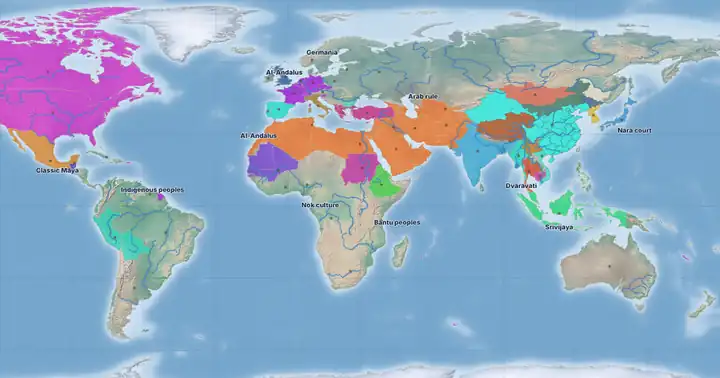
States and rulers by region
| Region | State or period | Ruler that year |
|---|---|---|
| France | Frankish Kingdom | — |
| Rome | Barbarian kingdoms | Aistulf |
| Egypt | Arab Caliphate | — |
| Mesopotamia | Abbasid Caliphate | al-Saffah |
| India | Harsha’s empire | Gopala (Pala dynasty) |
| China | Tang | Emperor Xuanzong |
| Japan | Nara period | Empress Koken |
| North Africa | Arab conquest | — |
| West Africa | Ghana Empire | — |
| Sudan | Christian Nubia | Kyriakos (Makuria) |
| Mexico | Rival city-states | — |
| Inca | Wari / Tiwanaku | — |
| Mongolia | Uyghur Khaganate | Bayanchur Khan |
| Indonesia | Srivijaya | — |
| Spain | Al-Andalus | Yusuf al-Fihri (governor) |
| Portugal | Al-Andalus | Yusuf al-Fihri (governor) |
| Thailand | Dvaravati | — |
| Vietnam | Sui–Tang rule | Chinese commandery rule (Tang · Protectorate of Annam) |
| Korean Peninsula | Unified Silla | King Gyeongdeok |
| Iran | Arab rule | al-Saffah (Abbasid) |
| Saudi Arabia | Umayyads & Abbasids | al-Saffah (Abbasid Caliph) |
| Uzbekistan | Arab conquest | Abu Muslim (leader of the Abbasid Revolution) |
| Poland | Slavic tribes | — |
| Netherlands | Frankish Kingdom | Pepin the Short (mayor of the palace, became king in 751) |
| Cambodia | Chenla | Split into Water Chenla and Land Chenla |
| Austria | Migration Period | — |
| Afghanistan | Turks & local rulers | — |
| Caribbean | Taíno & Lucayans | — |
The “Ruler that year” column comes from TimelineSurf's dated lists of rulers and heads of government. A blank means no record for that year, not that the region had no ruler. A few lists are incomplete, so the name may be the most recent one on record.
Events around this year
- 750Decline of the Moche culture
The Moche culture gradually broke down and disappeared amid El Niño climate events and political turmoil. - 750Pala dynasty founded
Local nobles in Bengal elected Gopala as king, founding the Pala dynasty. The Pala kings were patrons of Buddhism and supported centers of learning such as Nalanda and Vikramashila. - 750Douro valley becomes a buffer zone
After the Berber Revolt, the northern garrisons withdrew south, and Alfonso I of Asturias raided southward; the Douro basin was for a time sparsely populated, becoming a buffer zone between north and south (scholars debate how "deserted" it really was). - 751Battle of Talas
Papermaking spreads west. - 751Bulguksa and Seokguram
The Silla chief minister Kim Dae-seong oversaw the building of Bulguksa and Seokguram in Gyeongju (usually dated as begun in 751 CE), masterpieces of Buddhist art in Unified Silla. - 751Lombards capture Ravenna
Aistulf, King of the Lombards, seized the Byzantine Exarchate of Ravenna, and the Pope turned to the Franks for help. - 752Yang Guozhong becomes chancellor
Li Linfu died and Yang Guozhong succeeded him as chancellor, deepening his conflict with An Lushan. - 752Eye-opening of the Great Buddha at Todai-ji
The eye-opening ceremony was held for the Vairocana Buddha of Todai-ji, commissioned by Emperor Shomu, embodying the Nara court's ideal of Buddhism protecting the state.