Ganjin (Jianzhen)
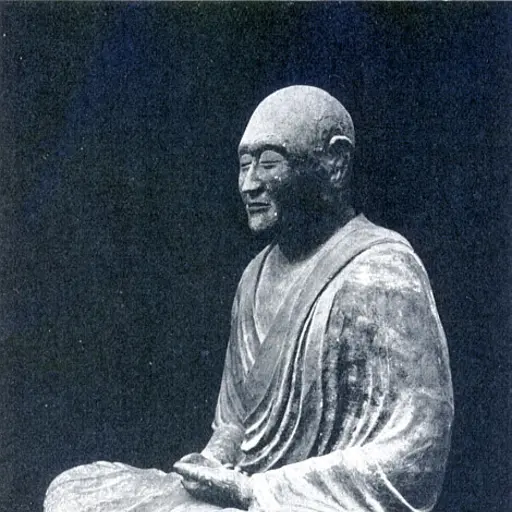

Went blind over six voyages east, but finally brought the Vinaya school and Tang culture to Japan.
Life
Vinaya master of Yangzhou
Ganjin (Jianzhen) came from a family in Yangzhou and became a monk at 14. He studied the Vinaya school of Buddhism as well as architecture, medicine and calligraphy, and by his forties was the recognized master of ordination in the Yangtze–Huai region. Japanese monks who came to China with the envoys to Tang begged him to go east and teach the proper precepts, since Japanese Buddhism at the time still lacked a strict ordination system.
Six Voyages East
Over the following decade or more he attempted the voyage east five times, failing each time because of shipwrecks, obstruction by officials or betrayal by companions, and along the way he lost his sight to illness. In 753 CE he finally reached Japan with the sixth fleet of envoys to Tang and was received with great honor by the court. At Todai-ji he set up an ordination platform and gave the precepts to the emperor and to monks, and he later founded Toshodai-ji.
Culture Spread East
He brought Tang architecture, sculpture, medicine and calligraphy to Japan together and had a profound influence on the founding of the Japanese Vinaya school; Toshodai-ji remains an important cultural heritage site today. Later accounts often embellish his voyages east into a smooth legend, but the sources clearly record repeated failures among the six attempts, wrecked ships, lost lives and his blindness, hardships far greater than the usual telling suggests.
Legacy
Ganjin (Jianzhen) is one of the most symbolic figures in the history of Sino-Japanese cultural exchange. He established a formal ordination system in Japan, completing the precepts of Japanese Buddhism, and Toshodai-ji, which he founded, became the head temple of the Vinaya school in Japan. The disciples and artisans who accompanied his voyage to Japan brought Tang-era architecture, sculpture and medical knowledge with them, with far-reaching influence. Based on the records of his disciple Situo, the Japanese man of letters Omi no Mifune wrote the "Account of the Eastern Journey of the Great Tang Master," the main source on his life.
Major works & achievements
- Reached Japan on his sixth voyage
- Set up an ordination platform at Todai-ji to transmit the precepts
- Founded Toshodai-ji
- Introduced Tang architecture, sculpture and medicine
Did you know? The dry-lacquer seated statue of Jianzhen kept at Toshodai-ji has been designated a National Treasure of Japan; in 1980 it was brought back to Yangzhou for exhibition.
Key dates
- 688Born in Jiangyang, Yangzhou
- 733First invited by Japanese monks to sail to Japan
- 743First voyage to Japan thwarted by a false accusation
- 748Fifth voyage blown off course to Hainan
- 753Sixth voyage reached Japan
- 754Set up an ordination platform at Todai-ji
- 759Built Toshodai-ji
- 763Died at Toshodai-ji