Du Fu
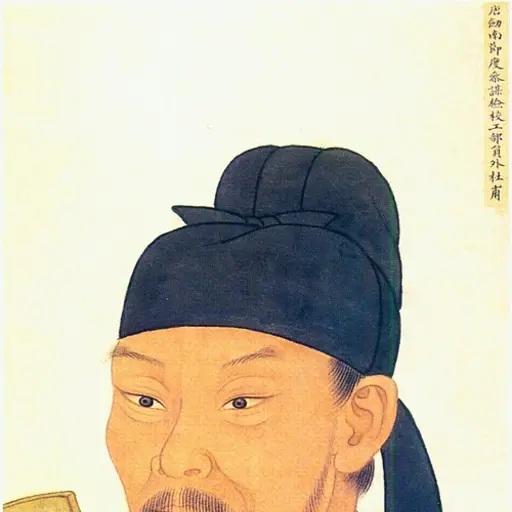

Recorded the suffering of a turbulent age in somber, measured verse and was revered by later generations as the Sage of Poetry.
Life
Stranded in Chang'an
Du Fu came from a family of officials. He failed the imperial examination early on and traveled through Qi, Zhao and Wuyue. During ten years stranded in Chang'an he repeatedly failed the exams and struggled to make a living, but this also let him observe the lives of ordinary people closely, gathering material for his later realistic style. After the An Lushan Rebellion broke out, he was captured by the rebels and held in Chang'an, then risked his life to join the court of Emperor Suzong of Tang.
Wandering in Shu
In 759, amid famine in the Guanzhong region, he gave up his post and took his family west into Shu, where he built a thatched cottage beside the Huanhua Stream in Chengdu and lived there for a time, writing famous works such as Spring View and My Thatched Hut Is Torn by the Autumn Wind. In his later years he drifted around Kuizhou and the Jing and Xiang region, and though poor and ill he kept writing; poem cycles such as the "Three Officials" and the "Three Partings" directly recorded the suffering of the common people in wartime.
Poet-Historian and Poet-Sage
Later generations called his poetry "poet-history"; its language is precise and its prosody rigorous, and it had an enormous influence on poetry from the Song dynasty on. In his lifetime Du Fu's fame as a poet was less brilliant than Li Bai's, and he drifted in poverty until his death. Only after the mid-Tang, when Yuan Zhen, Bai Juyi and others championed him, did his reputation gradually surpass those of many contemporaries, and this contrast of "neglect in life, glory in death" is often underestimated.
Legacy
Du Fu is revered as the "Sage of Poetry." His poems broadly record the social upheaval and the people's suffering before and after the An Lushan Rebellion, earning them the name "Poet-Historian." His rigorous innovations in regulated verse, especially the maturing of the seven-character regulated poem, set a model for later generations. His fame was limited in his lifetime; from the mid-Tang onward he was admired by Yuan Zhen and Bai Juyi, and Song scholars made him the supreme standard for learning poetry. His concern for his country and its people and his frustrated official career made him an important representative of the spirit of the Chinese literati.
Major works & achievements
- The "Three Officials" and "Three Farewells" poems
- Spring View
- My Thatched Hut Is Torn by the Autumn Wind
- Eight Autumn Meditations
- Paired with Li Bai as "Li–Du"
Did you know? More than 1,400 of his poems survive, placing him among the most prolific Tang poets.
Key dates
- 712Born in Gong County, Henan
- 746Struggled in Chang'an seeking office
- 755An Lushan Rebellion breaks out; trapped among the rebels
- 757Risked the journey to join Emperor Suzong at Fengxiang
- 759Gave up his post, entered Shu, and built the Thatched Cottage in Chengdu
- 765Left Shu, sailed east, and drifted to Kuizhou
- 768Left the Gorges to wander the Jing and Xiang region
- 770Died of illness on a boat on the Xiang River