Li Bai
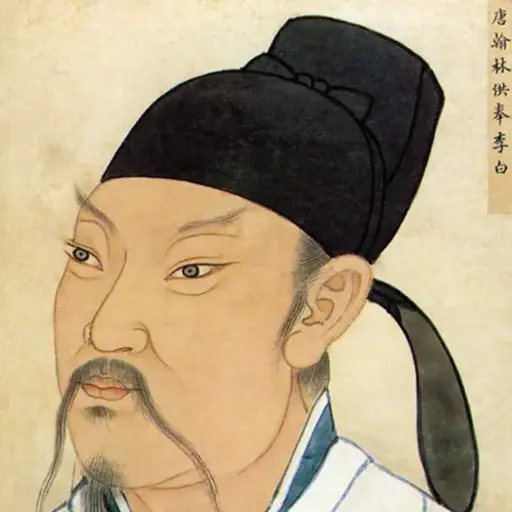

Revered by later generations as the Immortal of Poetry for his bold, free-spirited verse, he spent his life drinking and wandering.
Life
Youth in Shu
Li Bai was born either in Suyab in the Western Regions or in Shu; accounts differ. As a youth he studied and lived as a knight-errant in Sichuan, loved swordsmanship and travel, and also studied Daoism in search of immortality, deeply influenced by the ethos of the School of Diplomacy and of knights-errant. From his twenties he left home to travel far, visiting famous mountains and rivers and frequenting taverns to befriend scholars and recluses everywhere, and early on he became famous for his poetic talent and unrestrained temperament.
Hanlin Academician-in-Waiting
In 742 he was recommended by a Daoist priest and went to Chang'an, where Emperor Xuanzong summoned him and made him Hanlin Academician-in-Waiting. He wrote many court poems on command and poems expressing his feelings, but because he was proud of his talent and disdainful of the powerful, he was soon pushed out of the capital. For the next twenty years he wandered north and south, meeting Du Fu and forming a deep friendship with him. During the An Lushan Rebellion he joined the staff of Li Lin, Prince of Yong; after the prince's defeat he was implicated and exiled to Yelang, but was pardoned on the way.
Poetic Fame and Final Years
His poetry, wildly imaginative and exuberant in language, carried Romanticism to one of the peaks of Tang poetry, and he is paired with Du Fu as "Li-Du." A popular legend says he drowned while drunkenly trying to scoop up the moon's reflection, a poetic story with no reliable historical support. According to surviving records, he more likely died of illness at the home of his kinsman Li Yangbing in Dangtu, a fact often obscured by later romanticized accounts.
Legacy
Li Bai is revered by later generations as the "Immortal of Poetry." His poems are known for their unbridled imagination, free forms and intense personal feeling; he carried Music Bureau ballads and song-style verse to new heights and, together with Du Fu, represents the highest achievement of Tang poetry. His image grew ever larger in legends over the centuries, and stories such as his drowning while drunkenly reaching for the moon have no reliable basis. Some critics also point to his eagerness for fame and office and his joining Prince Yong's staff, arguing that he should not be understood solely as a carefree, otherworldly figure.
Major works & achievements
- Bring in the Wine
- The Road to Shu Is Hard
- Quiet Night Thoughts
- A Farewell Song of Wandering on Tianmu in a Dream
- Paired with Du Fu as "Li–Du"
Did you know? In his poem "Song of the Eight Immortals of the Wine Cup," Du Fu wrote of him: "When the Son of Heaven summoned him, he would not board the boat, calling himself the immortal of wine."
Key dates
- 701Born in the Western Regions or in Shu; accounts differ
- 725Left Shu to travel far, visiting famous mountains
- 742Summoned to the capital as Hanlin Academician-in-Waiting
- 744Left the capital to wander; met Du Fu
- 755Joined Prince Yong's staff after the An Lushan Rebellion broke out
- 757Prince of Yong defeated; Li Bai imprisoned and then exiled
- 759Pardoned and released on reaching Wushan
- 762Died of illness in Dangtu