Wang Wei
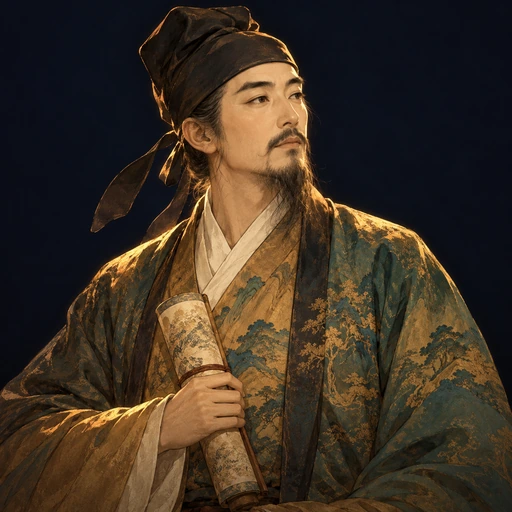
The "Buddha of Poetry," of whom Su Shi said, "there is painting in his poetry and poetry in his painting."
Life
Young prodigy
Wang Wei was already famed in his youth for poetry, music, calligraphy and painting, and passed the jinshi exam at 21. A devout Buddhist, he wrote poetry of ethereal tranquility, and later generations called him the "Buddha of Poetry."
Landscapes of Wangchuan
He bought a country estate at Wangchuan near Chang'an, where he went boating and exchanged poems with his friend Pei Di, producing the "Wangchuan Collection." Lines such as "In the empty mountains after fresh rain, the evening air turns to autumn" are regarded as models of landscape and pastoral poetry.
Surviving the rebellion
During the An Lushan Rebellion he was captured by the rebels and forced to accept a post under them. After the rebellion he should have been punished, but because he had written a poem expressing longing for the Tang, and his younger brother Wang Jin asked to give up his own office to atone for him, he was pardoned. He died in 761.
Legacy
Wang Wei was the leading figure of the High Tang school of landscape and pastoral poetry, and later generations also revered his painting as the origin of literati painting.
Major works & achievements
- "Autumn Evening in the Mountains"
- "Seeing Off Yuan the Second on a Mission to Anxi"
- "Wangchuan Collection"
Did you know? "I urge you to drink one more cup of wine; west of Yang Pass you will find no old friends" was later set to music as the famous piece "Three Refrains of Yang Pass."
Key dates
- 721Passed the jinshi exam
- 740Developed the Wangchuan estate (approx.)
- 756Captured by the rebels
- 758Pardoned
- 761Died