Taharqa
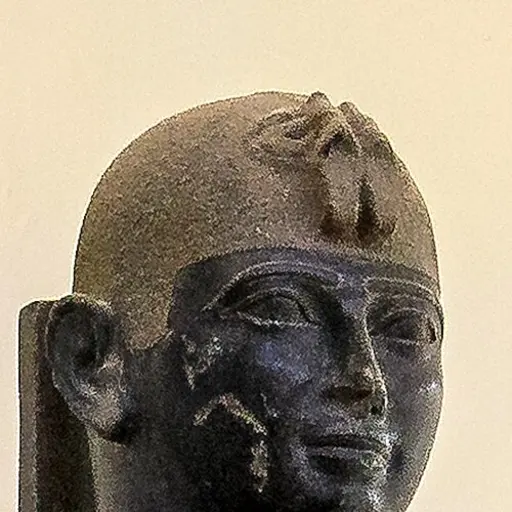

The most famous pharaoh of the 25th Dynasty, he ruled a vast realm stretching from Nubia to the Nile Delta and fought repeated wars against the Assyrian Empire.
Life
Accession and Campaigns
Taharqa was the son of Piye, king of Kush, and came to the throne c. 690 BCE, succeeding his brother Shebitku (scholars dispute the order of Shabaka and Shebitku). He was at once king of Kush at Napata and pharaoh of Egypt, ruling a vast region from the Fourth Cataract of the Nile to the Mediterranean. According to his inscriptions, before his accession he marched north with the army and took part in the campaign of 701 BCE, in which a Kushite-Egyptian force came to the aid of Judah against Sennacherib, King of Assyria.
Zenith and Revival
The early part of Taharqa's reign was the zenith of his state's power. He built extensively at Egyptian temples such as Karnak and Medinet Habu and at Jebel Barkal in Napata, and his inscriptions record a bumper harvest brought by an exceptionally great Nile flood. His art deliberately imitated the styles of the Old Kingdom and Middle Kingdom and is regarded as a conscious "revivalist movement."
Wars with Assyria
But the Neo-Assyrian Empire was on the rise. In 674 BCE he repelled an Assyrian attack, but in 671 BCE the Assyrian king Esarhaddon stormed Memphis and captured his queen and a prince, and Taharqa fled south. He later retook Memphis several times, only to be driven back south by the armies of Ashurbanipal. After his death in 664 BCE he was buried at Nuri, where his pyramid is the largest of the royal tombs; his successor Tantamani was soon driven out of Egypt.
Legacy
Taharqa was the most powerful ruler of the 25th Dynasty and is the "Tirhakah king of Cush" mentioned in the biblical Books of Kings, connected with the account of the Assyrian siege of Jerusalem. His revival of architecture and art left abundant remains in both Egypt and Nubia, but he was ultimately defeated in his struggle with Assyria, and Nubian rule over Egypt collapsed. Afterward the Kushite state withdrew to the south and continued to develop there.
Major works & achievements
- Built temples on a large scale at Karnak and Jebel Barkal
- Promoted an archaizing artistic style
- Repelled an Assyrian attack in 674 BCE
- Buried in the largest pyramid at Nuri
Did you know? He was the first Kushite king to be buried at Nuri rather than in the royal cemetery at El-Kurru, and his pyramid is the largest surviving one at Nuri.
Key dates
- 701 BCEMarched north with the Kushite-Egyptian army against Assyria (according to inscriptions)
- 690 BCEBecame King of Kush and Pharaoh of Egypt
- 685 BCEAn exceptionally great Nile flood; inscriptions record the bumper harvest
- 674 BCERepelled the Assyrian attack on Egypt
- 671 BCEAssyria storms Memphis; the queen and a prince are captured
- 667 BCEAshurbanipal marches south again; Taharqa retreats to Nubia
- 664 BCEDied; buried in the pyramid at Nuri