Ashurbanipal
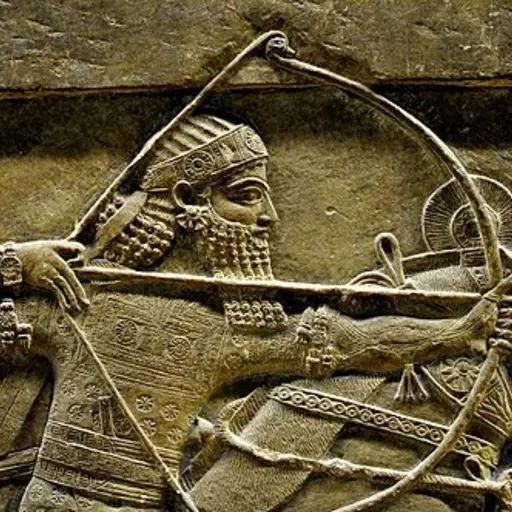

Sacked Thebes in Egypt and completed the Royal Library at Nineveh.
Life
Succession and Division of Realms
Ashurbanipal was the last great ruler of Assyria. When he came to the throne, the Neo-Assyrian Empire had expanded over several generations, stretching west to the Mediterranean and south to the Persian Gulf, but Egypt, Babylon, Elam and other lands wavered between rebellion and submission, and the royal family was divided over the succession; to keep the balance, his father had given Babylon to his elder brother as a separate kingdom.
Campaigns on All Fronts
After taking the throne he first sent an army to Egypt and captured Thebes, for a time bringing the Nile valley into the Assyrian realm. Later his elder brother rose in revolt in Babylon, and it took him several years to suppress it; he then marched east, destroyed Elam and captured its capital, Susa. At Nineveh he ordered the copying and cataloguing of the texts and writings accumulated in Mesopotamia over thousands of years.
The Library and Twilight
The clay tablets of the Royal Library at Nineveh were buried in the ruins when the empire fell; unearthed in the 19th century, they became the most important primary sources for the study of Sumerian and Akkadian literature and the Epic of Gilgamesh. In his later years the empire was already in decline and his successors fought among themselves endlessly; twenty years later Assyria fell to a coalition of the Medes and the Neo-Babylonian Empire.
Legacy
Ashurbanipal took pride in his mastery of writing and learning, something rare among ancient monarchs. The tens of thousands of clay tablets collected under his direction were preserved by chance in the ruins of Nineveh and became the most important treasure trove for reconstructing the literature, religion, and science of Mesopotamia. During his reign Assyria was still mighty, but its campaigns were brutal, above all the destruction of Elam. Less than twenty years after his death, Nineveh fell in 612 BCE and the empire collapsed.
Major works & achievements
- Sacked Thebes in Egypt
- Crushed his elder brother's Babylonian revolt
- Destroyed Elam and captured Susa
- Founded the royal library at Nineveh
Did you know? The "Lion Hunt reliefs" from his palace depict the king slaying lions; now in the British Museum, they are regarded as the pinnacle of Assyrian relief art.
Key dates
- 685 BCEBorn into the Assyrian royal family
- 668 BCESucceeded to the Assyrian throne
- 663 BCESacked Thebes in Egypt
- 652 BCECrushed his elder brother's revolt in Babylon
- 646 BCEDestroyed Elam and burned Susa
- 640 BCECompleted the Royal Library at Nineveh
- 627 BCEDied; the empire passed from its height into decline