Yajnavalkya
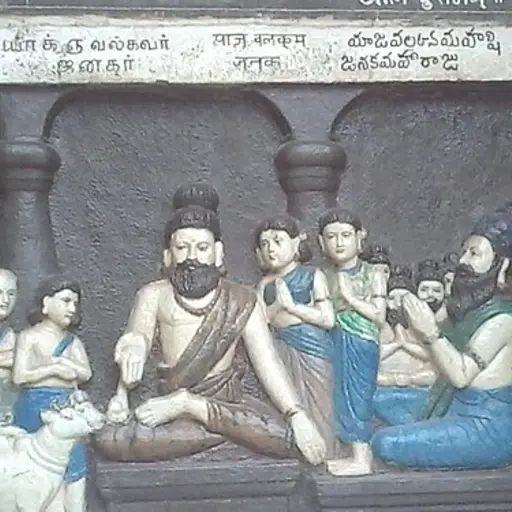

Sage of the Upanishads who expounded the unity of Brahman and Atman.
Life
Debates at Court
Yajnavalkya is said to have been active at the court of King Janaka of Videha in the middle Ganges region, at a time when the Brahmanical tradition of sacrificial ritual was gradually giving way to inquiry into abstract philosophical ideas such as "Brahman" and "Atman," giving rise to the Upanishadic movement.
Unity of Brahman and Atman
In several debates with his wife Maitreyi and with court scholars, he expounded the unity of Brahman and Atman, holding that knowing one's inner true self leads to liberation. His sayings were later included in classic texts such as the Brihadaranyaka Upanishad, and they are among the earliest and most systematic statements of the doctrine of Brahman and Atman in the history of Indian philosophy.
One Person or a School
Scholarly estimates of Yajnavalkya's dates vary widely, ranging from the 8th century BCE to later. Some scholars believe the name may represent the collective wisdom accumulated by a school over a long period rather than a single historical person, in contrast to contemporary thinkers such as Mahavira and Gautama Buddha, whose periods of activity are clearly recorded.
Legacy
Yajnavalkya is regarded as one of the most important thinkers of the age of the Upanishads. He described the ineffable true Self through negation, "not this, not that," profoundly influencing later Vedanta philosophy. His dialogue with his wife Maitreyi on whether wealth can bring immortality is a classic passage in Indian thought on the relationship between liberation and worldly wealth. Indian tradition also attributes a dharma treatise to him.
Major works & achievements
- Expounded the doctrine of the unity of Brahman and Atman
- Teachings recorded in the Brihadaranyaka Upanishad
- Traditionally said to have transmitted the White Yajurveda
Key dates
- 750 BCESaid to have been active at the court of Videha
- 720 BCEDebated Brahman and Atman with his wife Maitreyi
- 700 BCEExpounded the Unity of Brahman and Atman
- 680 BCETeachings recorded in the Brihadaranyaka Upanishad
- 650 BCEHis ideas were repeatedly edited and compiled by later generations