Tiglath-Pileser III
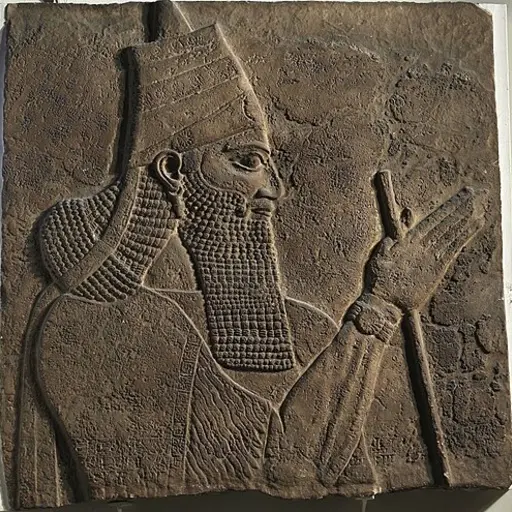

Reformed the provincial system and the standing army, reviving the Neo-Assyrian Empire.
Life
Seized the Throne in a Coup
Tiglath-Pileser III was of unknown origins and is believed to have seized the Assyrian throne in a coup. Before him, the Neo-Assyrian Empire had suffered decades of internal strife and the growing power of provincial governors; central authority had weakened, the neighboring Syrian states and Urartu were nibbling away at its borders, and for a time the empire was on the verge of breaking apart.
Reform and Conquest
After taking the throne he abolished the old system of hereditary governors ruling semi-independent domains, splitting the large provinces into smaller ones placed directly under the center; he formed a standing army maintained by the crown to replace feudal levies, and pioneered the policy of forcibly deporting conquered peoples to prevent rebellion. Militarily he campaigned year after year, conquering the Syrian states one after another, capturing Damascus, and also becoming King of Babylon.
Foundations of Empire
His provincial and standing-army reforms laid the institutional foundations for later rulers such as Sargon II and Ashurbanipal, allowing Neo-Assyria to sustain a great multiethnic empire for nearly a hundred years. Although forced deportation made rule more efficient, it also uprooted large numbers of peoples, and the numbers of deportees given in the sources are exaggerated and cannot be fully trusted.
Legacy
Tiglath-Pileser III is regarded as the true founder of the Neo-Assyrian Empire. He transformed a loose tributary system into an imperial structure ruled directly through provinces, a model later inherited by the Neo-Babylonian Empire and Persia. The Bible calls him "Pul" and records that he exacted silver tribute from Israel and deported part of its population, making him an important external reference for the history leading up to Israel's fall.
Major works & achievements
- Broke up the large provinces and placed them under direct central rule
- Formed a royal standing army
- Imposed forced deportation on conquered peoples
- Captured Damascus; also became king of Babylon
Did you know? When he became king in Babylon he used the name "Pulu," which corresponds exactly to "Pul" in the biblical Books of Kings.
Key dates
- 745 BCESeized the throne as King of Assyria
- 743 BCEReformed the provincial system and the standing army
- 738 BCEConquered the states of northern Syria
- 732 BCECaptured Damascus
- 729 BCEAlso became King of Babylon
- 727 BCEDied