Homer
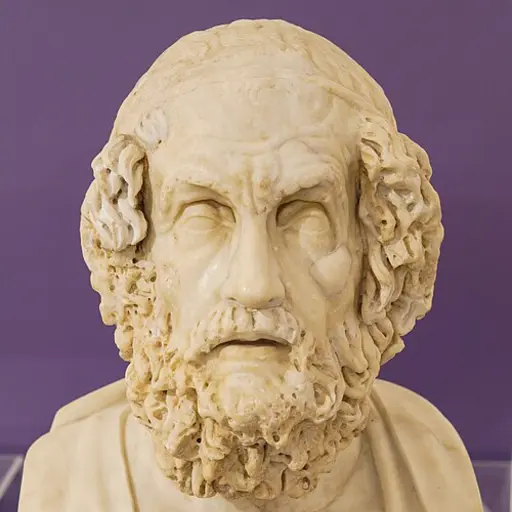

The poet traditionally credited with the Iliad and the Odyssey.
Life
Legend of the Blind Poet
Homer is the author to whom ancient Greek tradition attributed the two epics, the Iliad and the Odyssey. The ancient Greeks generally believed he really existed; legend made him a blind wandering bard, and his birthplace was much disputed, with Smyrna, the island of Chios and other places all claiming him as their native son.
Two Great Epics
The two epics take as their subject the legends of the Trojan War and the heroes' homecomings afterward. They blend historical memories of the Mycenaean age with formulaic phrases accumulated over centuries of oral recitation, and took basic shape around the 8th century BCE. They were then transmitted orally for several more centuries, until in the 6th century BCE Athens had them edited into a relatively fixed text for recitation contests at the Panathenaic festival.
The Homeric Question
Modern scholars have debated the "Homeric Question" for more than two centuries: the two epics differ in style and vocabulary, and it remains unresolved whether they were written by the same person, and whether they are the independent creation of a single author or the collective product of generations of bards. "Homer" is most likely a symbolic author's name that later generations gave to this vast oral literary tradition.
Legacy
The Homeric epics were the core texts of education in Ancient Greece, from which Greeks learned language, religion, ethics and heroic ideals; the ancients regarded Homer as the teacher of all Greece. The two epics established the narrative paradigms of Western literature and are still adapted again and again. In the 20th century Parry and Lord compared them with Yugoslav oral epics and demonstrated the oral-formulaic character of the Homeric poems, profoundly changing the discussion of the Homeric Question.
Major works & achievements
- Iliad
- Odyssey
- The Homeric Hymns are attributed to him (actually written by later authors)
Did you know? In the 19th century Schliemann followed clues in Homer's epics to excavate the mound of Hisarlik in Turkey, finding the ruins of an ancient city widely identified as Troy.
Key dates
- 800 BCEOral recitation tradition matured
- 750 BCEIliad largely took shape
- 725 BCEOdyssey followed
- 700 BCEThe two epics were widely recited across the Greek city-states
- 550 BCEAthens established a more fixed text