Chavín Priest (unnamed)
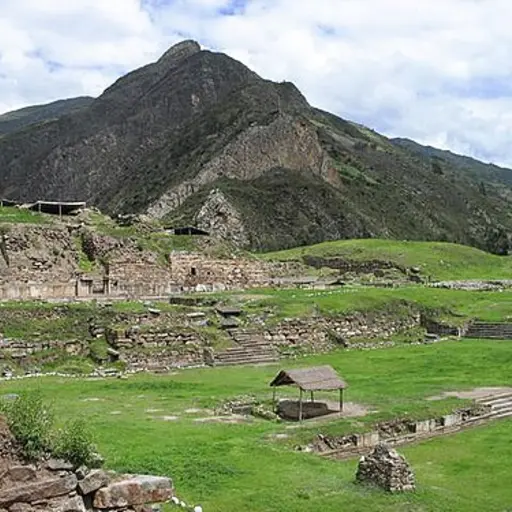

Religious leader of a pilgrimage center in the Andean highlands.
Life
Valley Sanctuary
Chavín de Huántar stands at a strategic point in a river valley in the Andes of Peru. In the mid-1st millennium BCE it developed into one of the most important centers of religious pilgrimage and trade in the central Andes, and its influence spread along mountain paths to early societies across the coast and highlands.
Oracles and Priests
At the heart of the site stands the "Lanzón," a stone monolith about four meters tall carved all over with jaguar and serpent-eagle motifs. Archaeologists infer the existence of a priestly class that controlled this oracle and organized pilgrimage rituals and long-distance trade networks, through which rare goods obtained in exchange, such as Pacific Ocean shells and obsidian, were distributed via Chavín throughout the Andes.
Anonymous Authority
The Chavín culture likewise left no decipherable written records. The "priest" referred to here is a role inferred from stone carvings, architectural layout and offerings, not a specific, verifiable individual; their names, terms of office and lineages cannot be traced. How religious authority actually worked in early Andean societies remains a subject of ongoing debate among archaeologists.
Legacy
Chavín culture was the first in the Andes to spread a unified religious iconography over a wide area and is often regarded as one of the key sources of Andean civilization. The intricate underground galleries, water channels and features possibly designed to produce sounds inside the temple show that the priestly class skillfully used architecture to create mystical experiences that reinforced its authority. The site of Chavín de Huántar was inscribed on the World Heritage List in 1985.
Major works & achievements
- Presided over the oracles and rites of the Lanzón idol
- Organized cross-regional pilgrimage and trade networks
- Built a temple with underground galleries
Did you know? Conch-shell trumpets carved with patterns have been unearthed at the site, and scholars believe they were used to create sound effects during rituals.
Key dates
- 1200 BCEEarly construction at Chavín de Huántar
- 900 BCEOld Temple and Lanzón stela take shape
- 800 BCEBecame a pan-Andean center of pilgrimage and trade
- 500 BCEThe New Temple was expanded and its influence spread far
- 200 BCEChavín influence declined