Isaac Newton
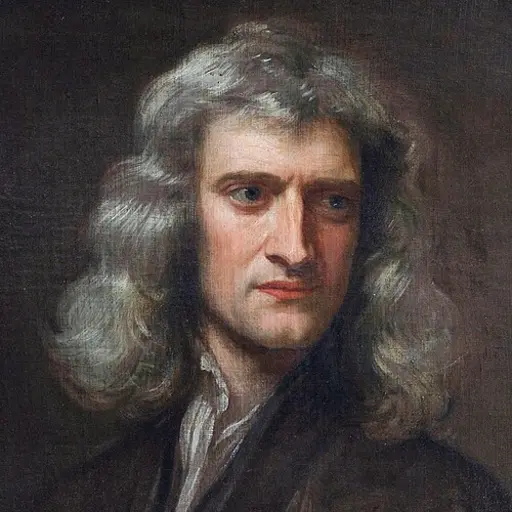

Formulated the laws of motion and universal gravitation, establishing the system of classical mechanics.
Life
Country boy
Newton was born into a yeoman farming family in Lincolnshire after his father's death and was raised by his grandmother. In 1661 he entered Trinity College, Cambridge; in 1665, when the university closed because of the plague, he returned home for two years, during which he formed his first ideas on calculus, the dispersion of light and universal gravitation, a period later called his miracle year.
The Principia appears
With prism experiments he showed that white light is made up of colored rays with different refractive indices, and he built a reflecting telescope; he devised the method of fluxions and became embroiled in a priority dispute with Leibniz. In 1687, with Halley's funding, he published Philosophiae Naturalis Principia Mathematica (Mathematical Principles of Natural Philosophy), setting out the three laws of motion and the law of universal gravitation and bringing celestial and terrestrial motion into a single mathematical framework.
The Mint and later years
In the second half of his life he served as Master of the Royal Mint and President of the Royal Society, reforming the coinage and cracking down hard on counterfeiters, and he also devoted great effort to alchemy and theological chronology. His mechanics dominated physics for more than two centuries, until the theory of relativity and quantum mechanics marked out the limits of its validity.
Legacy
Newton is recognized as one of the greatest scientists in human history. With a single mathematical system he unified the motion of the heavens and of the earth, laying the foundations of classical mechanics and modern scientific method and profoundly shaping the worldview of the Enlightenment. His priority dispute with Leibniz over calculus, his harsh treatment of critics, and his long devotion to alchemy and theology also make up a more complex figure than a "paragon of reason."
Major works & achievements
- Philosophiae Naturalis Principia Mathematica (Mathematical Principles of Natural Philosophy)
- The three laws of motion and the law of universal gravitation
- Developed the method of fluxions (calculus)
- Opticks and the reflecting telescope
Did you know? He lost money in the South Sea Bubble of 1720; by one account he lost about 20,000 pounds.
Key dates
- 1661Entered Trinity College, Cambridge
- 1666Returns home to escape the plague; conceives calculus and gravitation
- 1669Became Lucasian Professor of Mathematics
- 1672Elected Fellow of the Royal Society; publishes a paper on optics
- 1687Publishes Philosophiae Naturalis Principia Mathematica
- 1696Became Warden of the Royal Mint
- 1703Elected President of the Royal Society
- 1704Published Opticks
- 1727Died; buried in Westminster Abbey