John III Sobieski
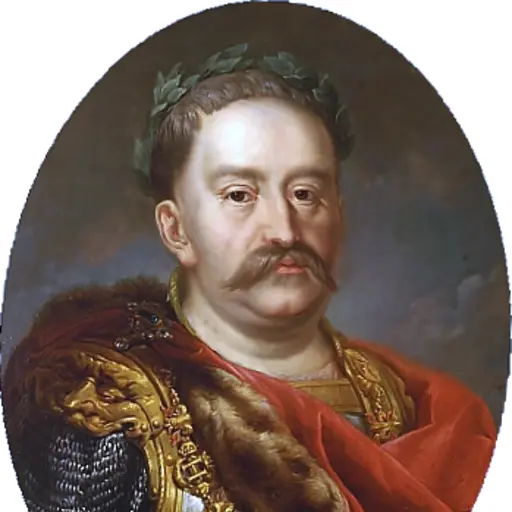

King of Poland–Lithuania elected on the strength of his military record, who led allied forces to relieve the Siege of Vienna in 1683; the last commander of the Commonwealth to win fame across Europe.
Life
Raised in a military family
Jan Sobieski was born in 1629 in Olesko, in present-day western Ukraine, to a prominent family; as a young man he traveled in Western Europe and learned several languages. He came of age amid the Commonwealth's incessant wars of the mid-17th century, fighting against the Cossacks, Sweden, Russia and the Tatars, and rose step by step to become Grand Crown Hetman (commander-in-chief of the army). In 1673 he inflicted a crushing defeat on the Ottoman army at Khotyn, and his prestige reached its peak.
Elected king
In 1674 Sobieski was elected king at the election sejm, taking the name John III. He hoped to strengthen royal power and improve the Commonwealth's finances and army, but he was constrained by the noble-dominated Sejm and the liberum veto, and many of his plans could not be realized. In diplomacy he allied with Holy Roman Emperor Leopold I against the Ottoman Empire. When the main Ottoman army besieged Vienna in 1683, he personally led the Polish army to the city, joined the forces of the imperial princes, and on September 12 commanded the allied general assault from the Kahlenberg; the charge of the Polish winged hussars routed the besieging army.
Hero of Vienna
The relief of Vienna made Sobieski a hero admired throughout Europe. He afterward joined the Holy League to continue the war against the Ottomans, but goals such as recovering Podolia were not achieved in his lifetime. He spent his last years at Wilanów Palace outside Warsaw and died in 1696. Wilanów Palace survives intact today and is a prime example of Polish Baroque architecture.
Legacy
Sobieski was the last commander of the Polish–Lithuanian Commonwealth to win renown throughout Europe; the Relief of Vienna is regarded as the turning point in the Ottoman Empire's expansion into Central Europe, and it earned him the title "defender of Christendom." At home, however, he was unable to remedy the long-standing ills caused by the noble-dominated Sejm and the liberum veto, and the Commonwealth declined rapidly after his death. Historians therefore often use the contrast between his military glory and political impotence to illustrate the Commonwealth's predicament.
Major works & achievements
- Routed the Ottoman army at the Battle of Khotyn in 1673
- Led allied forces to relieve the Siege of Vienna in 1683
- Built Wilanów Palace
Did you know? The astronomer Hevelius named the constellation Scutum in his honor; it was originally called "Sobieski's Shield."
Key dates
- 1629Born in Olesko
- 1655Fought during the Swedish Deluge
- 1668Promoted to Grand Crown Hetman
- 1673Routed the Ottoman army at the Battle of Khotyn
- 1674Elected King of Poland
- 1683Led allied forces to relieve the Siege of Vienna
- 1696Died at Wilanów Palace