Narai
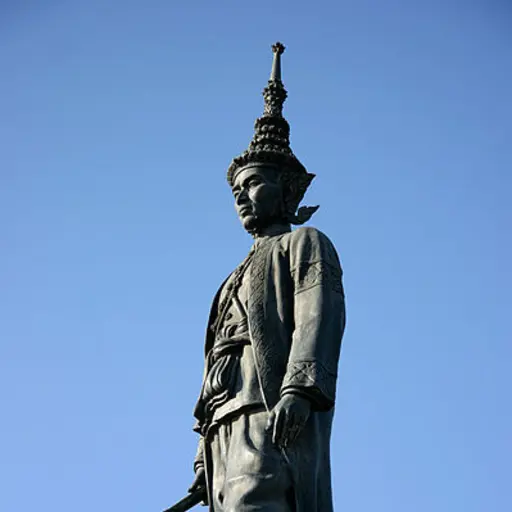

Siamese king who broadened foreign relations and exchanged embassies with Louis XIV.
Life
Seizing the throne at court
Narai, the son of King Prasat Thong, defeated his uncle and elder brother in a series of court struggles and took the throne in 1656. By the time he came to power, the Dutch East India Company's influence in Siam was growing, and in 1664 it went so far as to blockade the mouth of the Chao Phraya River, forcing Siam to sign a treaty granting it a trade monopoly and extraterritoriality. This led Narai to seek other foreign powers as a counterweight.
Open diplomacy
He appointed the Greek adventurer Phaulkon to manage foreign trade and actively courted England and France. In 1685 he received the Chaumont embassy sent by Louis XIV, and the following year he sent an embassy led by Kosa Pan on a return visit to Versailles, where it caused a sensation in France. Narai also built up Lopburi as a second capital; his court drew Persian, Japanese, Chinese and European merchants and scholars, and Siamese literature flourished in his reign.
Coup and aftermath
France, however, hoped the king would convert to Catholicism and sought to station troops in Bangkok and Mergui, causing deep unease at court and in the country. In 1688, as Narai lay gravely ill, Phetracha, commander of the elephant corps, staged a coup, executed Phaulkon and expelled the French troops; Narai died soon afterward. Later assessments of him differ: some praise his open-minded vision, while others argue that he relied too heavily on foreigners and nearly let Siam fall under colonial control.
Legacy
King Narai's reign was one of the periods when Ayutthaya's foreign relations were most active and its court culture most flourishing. He skillfully exploited rivalries among the foreign powers to protect Siam's interests and is regarded as an outward-looking monarch in Thai history. But his reliance on foreign advisers provoked a backlash at court and in the country, ultimately leading to the coup of 1688 and a long period of wariness toward the West afterward. Opinion on the merits of his open policy remains divided to this day.
Major works & achievements
- Built Lopburi as a second capital
- Received the French embassy of Chaumont
- Sent Kosa Pan's embassy to Versailles
- Used England and France to counter the Dutch
Key dates
- 1632Born in Ayutthaya
- 1656Takes the throne after a palace struggle
- 1664Forced to sign a trade treaty with the Netherlands
- 1666Builds Lopburi as a second capital
- 1685Received the French embassy of Chaumont
- 1686Sends Kosa Pan's embassy to Versailles
- 1688Phetracha stages a coup as he lies gravely ill; dies soon after