Louis XIV
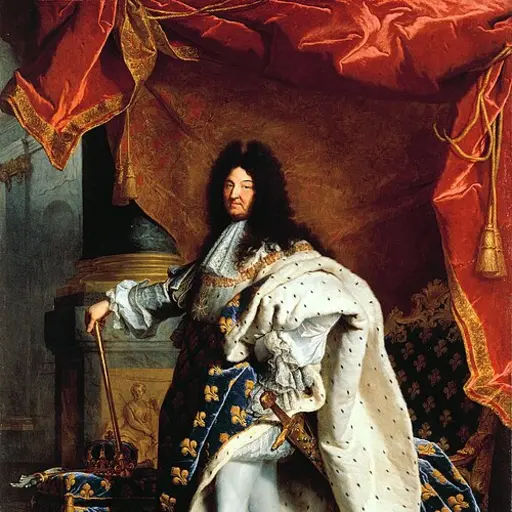

Established the model of absolute monarchy and built the court at Versailles.
Life
Boy king and the Fronde
Louis XIV came to the throne at four, with his mother the queen and the chief minister Mazarin as regents. As a boy he lived through the Fronde, the revolt of the nobility, and this turbulent experience made him, as an adult, extremely wary of the nobles' centrifugal tendencies. After Mazarin died in 1661 he announced his personal rule, appointed no further chief minister, and concentrated all power in his own hands.
Versailles and expansion
He employed Colbert to reform the finances, industry and commerce, expanded the standing army, and waged several foreign wars to push out the northeastern frontier. In 1682 he moved the court to the newly built Palace of Versailles, binding the nobility to court through elaborate etiquette and entertainments and weakening their local power; absolute royal power, of the "I am the State" kind, reached its peak here.
Peak and decline
In his later years, years of continual war drained the treasury, and the 1685 revocation of the Edict of Nantes and expulsion of the Protestant Huguenots cost France large numbers of skilled artisans, and the nation's strength turned from ascendancy to decline. The glorious image of the "Sun King" was largely propaganda deliberately crafted by court art; at his death France's finances were near bankruptcy, sowing the seeds of later crises for the Bourbon dynasty.
Legacy
Louis XIV is seen as the model of European absolute monarchy. He strengthened centralization and supported commerce, industry, scholarship and the arts, making France the most powerful state in Europe in the late 17th century, while the French language and the court culture of Versailles became fashionable across the continent. But continual wars and an extravagant court exhausted the treasury, and the expulsion of the Huguenots damaged the economy; these legacies are considered among the long-term causes of the later French Revolution.
Major works & achievements
- Ruled without a chief minister after taking personal power
- Employed Colbert to reform the finances
- Moved the court to Versailles
- Revoked the Edict of Nantes
Did you know? He reigned for seventy-two years, making him one of the longest-reigning monarchs in European history.
Key dates
- 1643Became King of France
- 1648Fronde revolt of the nobles broke out
- 1661Mazarin died; announced his personal rule
- 1667Launched the War of Devolution for territorial Expansion
- 1682Moved to the Palace of Versailles
- 1685Revoked the Edict of Nantes and expelled the Huguenots
- 1701Embroiled in the War of the Spanish Succession
- 1715Died at Versailles