Sor Juana Inés de la Cruz
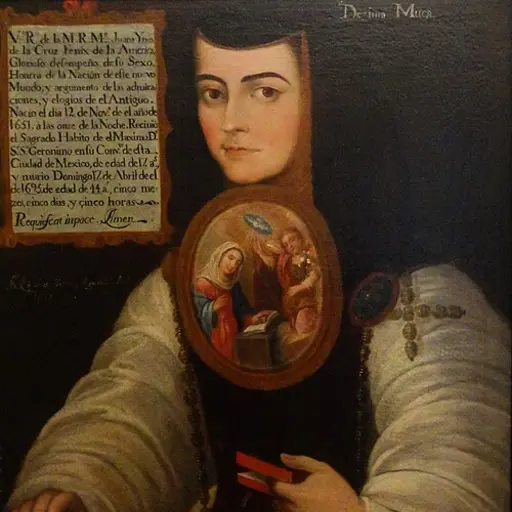

Read widely in the convent and defended women's right to learning in her writings.
Life
Child prodigy
Juana was born on an estate near Mexico City in New Spain and showed an astonishing gift for reading from childhood; as a girl she once wanted to disguise herself as a man to sneak into university lectures, but did not succeed. Colonial society at the time did not allow women to formally enroll in university. For a time she was honored at the court of the viceroy's wife for her outstanding learning, and later chose to enter a convent to gain relative freedom to read and write.
Writing in the convent
In the Convent of San Jerónimo she amassed a library of several thousand volumes, studied theology, mathematics, music and literature, and wrote a large body of poetry, plays and philosophical prose. In 1690 she anonymously published a critique of a theological sermon, and a bishop, writing under the pseudonym "Sor Filotea," sent her a letter admonishing that women should keep away from learning. She promptly wrote the "Reply to Sor Filotea," a systematic defense of women's right to education and to think.
Silence and legacy
In her later years, under pressure from the Church, she was forced to sell her books and musical instruments and to sign penitential documents renouncing scholarly writing, and soon after she fell ill and died while caring for nuns stricken by the plague. Her "Reply to Sor Filotea" has since been regarded as one of the earliest feminist texts in Latin America, but some scholars note that modern feminist concepts should not be applied directly to a colonial context three hundred years ago; her aim was more to win room for reading within the existing church framework than to challenge the established order wholesale.
Legacy
Hailed as the "Tenth Muse," Juana is one of the leading poets of Spanish-language Baroque literature and the most important writer of colonial Latin America. Her defense of women's right to knowledge has made her an iconic figure in the culture of Mexico and of Latin America as a whole. Scholars still debate why she gave up writing in her final years: whether she was forced to submit or made a personal religious choice, with evidence on both sides.
Major works & achievements
- Reply to Sor Filotea
- The long poem First Dream
- The play The Trials of a Noble House
- Many sonnets and religious plays
Did you know? Her portrait once appeared on Mexico's 200-peso banknote.
Key dates
- 1664Became a lady-in-waiting at the viceroy's wife's court
- 1667Briefly entered a convent of the Franciscans
- 1669Moved to the Convent of San Jerónimo
- 1680Wrote many poems and plays
- 1690Her theological critique sparked controversy
- 1691Wrote the Reply to Sor Filotea
- 1693Forced to give up scholarly writing
- 1695Died while nursing nuns stricken by plague