The world in 1911
1911, China: Qing (Xuantong); Iran: Qajar dynasty (Ahmad Shah); India: British Raj (Hardinge (of Penshurst)); Rome: Kingdom of Italy (Victor Emmanuel III). The main event that year: Xinhai Revolution.
1911: the table below lists the states and rulers of 49 regions of the world, followed by 14 events from around that year.
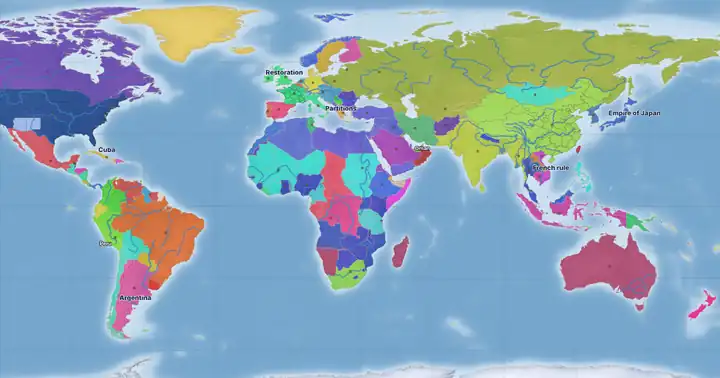
States and rulers by region
| Region | State or period | Ruler that year |
|---|---|---|
| United States | United States of America | Taft |
| United Kingdom | British Empire | Salisbury |
| France | French Republic | Grévy |
| Germany | German Empire | William II |
| Rome | Kingdom of Italy | Victor Emmanuel III |
| Turkey | Ottoman Empire | Mehmed V |
| Egypt | British occupation & Kingdom of Egypt | Abbas II (Khedive) |
| Russia | Russian Empire | Nicholas II |
| Scandinavia | Sweden · Norway · Denmark | Haakon VII (Norway) |
| India | British Raj | Hardinge (of Penshurst) |
| China | Qing | Xuantong |
| Japan | Meiji era | Saionji Kinmochi |
| Greece | Kingdom of Greece | — |
| North Africa | French North Africa | — |
| West Africa | French West Africa | — |
| Ethiopia | Solomonic dynasty | Menelik II |
| Sudan | Anglo-Egyptian Sudan | Wingate (governor) |
| East Africa | German & British East Africa | Kinjikitile (Maji Maji Rebellion) |
| Central African Republic | Congo Free State | Albert I (King of the Belgians) |
| South Africa | Union of South Africa | Louis Botha |
| Nigeria | British Nigeria | Lugard (High Commissioner of Northern Nigeria) |
| Ghana | British Gold Coast | Matthew Nathan (Governor) |
| Mexico | Mexican Revolution | Francisco Madero |
| Maya | Guatemala · Honduras · Belize | — |
| Inca | Peru · Bolivia · Ecuador | — |
| Mongolia | Outer Mongolian autonomy / independence | Bogd Khan (8th Jebtsundamba) |
| Indonesia | Dutch East Indies | — |
| Australia | Commonwealth of Australia | Deakin |
| Spain | Restoration | Alfonso XIII (personal rule) |
| Portugal | First Republic | Arriaga (president) |
| Thailand | Chakri dynasty | Rama VI Vajiravudh |
| Vietnam | French rule | Emperor Duy Tân, Nguyễn Phúc Vĩnh San (Nguyễn dynasty nominal emperor) |
| Korean Peninsula | Japanese colonial rule | Terauchi Masatake (Japanese Governor-General of Korea) |
| Iran | Qajar dynasty | Ahmad Shah |
| Saudi Arabia | Third Saudi State | Abdulaziz Ibn Saud (Emir of Riyadh) |
| Uzbekistan | Russian Central Asia | Nicholas II (Tsar) |
| Poland | Partitions | Nicholas II (Tsar) |
| Netherlands | Kingdom of the Netherlands | Wilhelmina (personal rule) |
| Cambodia | French protectorate | Sisowath |
| Myanmar | British Burma | Burma Province of British India (Lieutenant Governor) |
| Brazil | Old Republic | Hermes da Fonseca |
| Argentina | Conservative Republic | Roque Sáenz Peña |
| Canada | Dominion of Canada | Borden |
| Austria | Austria-Hungary | Franz Joseph I |
| Ireland | Part of the United Kingdom | George V |
| Afghanistan | Barakzai dynasty | Habibullah |
| Caribbean | US influence | — |
| Baltic states | Baltic provinces of the Russian Empire | — |
| Guyana | Indentured labor era | — |
The “Ruler that year” column comes from TimelineSurf's dated lists of rulers and heads of government. A blank means no record for that year, not that the region had no ruler. A few lists are incomplete, so the name may be the most recent one on record.
Events around this year
- 1910Republican Revolution
On October 5 a republican uprising overthrew the monarchy; Manuel II went into exile in the United Kingdom, and Portugal's First Republic was proclaimed. - 1910Japan annexes Korea
Japan forced the Korean Empire to sign the Japan–Korea Annexation Treaty and set up the Government-General of Korea, beginning 35 years of colonial rule over the peninsula. - 1910Union of South Africa founded
The Cape, Natal, the Transvaal and the Orange River Colony were merged into the Union of South Africa, a British dominion; Louis Botha became its first prime minister, and the vote was largely restricted to whites. - 1910Mexican Revolution breaks out
Madero called for opposition to Díaz's reelection, and uprisings broke out in many places from November 20; the following year Díaz went into exile, and the revolution then descended into a multi-sided melee. - 1910"Treaty of Punakha"
Bhutan signed a treaty with Britain agreeing to accept British "guidance" in foreign affairs, while Britain pledged not to interfere in Bhutan's internal affairs. - 1911Xinhai Revolution
The Wuchang Uprising ends two thousand years of imperial rule. - 1911Independence of Outer Mongolia
During the Xinhai Revolution, Outer Mongolia declared independence at Urga and enthroned the Jebtsundamba as Great Khan. - 1911Independence of Khüree (Urga)
During the Xinhai Revolution, Outer Mongolia declared independence at Urga and enthroned the 8th Jebtsundamba as Bogd Khan; successive Chinese governments long refused to recognize it. - 1911Italo-Turkish War
Italy attacked the Ottoman dependencies of Tripolitania and Cyrenaica, gaining Libya the following year. - 1911Bingham reaches Machu Picchu
The American scholar Hiram Bingham, guided by local farmers, reached Machu Picchu; after his reports, this Inca site became world-famous. - 1911Constitution of 1911
The Constituent Assembly adopted the Republic's Constitution, establishing a parliamentary system and the separation of church and state. - 1911Díaz goes into exile
After the revolutionary army took Ciudad Juárez, Díaz, who had ruled for more than thirty years, resigned and went into exile in France, and Madero was elected President. - 1911Capital moved to Delhi
King George V held a coronation durbar in Delhi and announced that the capital of British India would move from Calcutta to Delhi; New Delhi was built afterward. - 1912Qing emperor abdicates · Republic founded
Sun Yat-sen took office as provisional president and a provisional government was established in Nanjing; the Qing emperor abdicated and imperial rule came to an end.