Albert Einstein
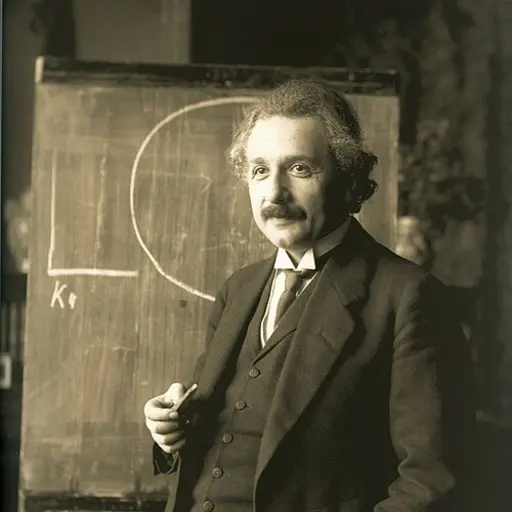

Created the theory of relativity, redefining time, space and gravity.
Life
Patent office years
Einstein was born into a Jewish family in Ulm, Germany. After finishing university in Switzerland he failed to obtain a teaching post and began work at the Bern patent office. Physics at the end of the 19th century faced a succession of irreconcilable contradictions concerning the ether, blackbody radiation and electrodynamics, setting the stage for a fundamental theoretical upheaval.
Miracle year and relativity
In 1905 he published five papers in quick succession, proposing the light quanta hypothesis to explain the photoelectric effect, using Brownian motion to confirm the reality of molecules, founding special relativity and deriving the mass-energy relation. In 1915 he completed general relativity, explaining gravity as the curvature of spacetime; observations during the 1919 solar eclipse confirmed the bending of light, making him world-famous.
Nobel and exile
In 1921 he won the Nobel Prize in Physics. After the Nazi seizure of power he moved to the United States, and in 1939 co-signed a letter to Roosevelt warning of the danger of the atomic bomb; after the war he actively championed nuclear disarmament and peace. He opposed the probabilistic interpretation of quantum mechanics all his life, and the resulting debates spurred continuing research into the foundations of physics.
Legacy
Einstein's theory of relativity changed humanity's understanding of time, space and gravity, and his light quanta hypothesis was an important starting point of quantum theory. He is widely regarded as one of the greatest physicists of the 20th century, and he was also a public intellectual who opposed war and racism. In his later years his pursuit of a unified field theory was unsuccessful, and he never accepted the probabilistic interpretation of quantum mechanics; this was seen as conservative at the time, but it also spurred ongoing inquiry into the foundational questions of quantum theory.
Major works & achievements
- Created special relativity in 1905
- Proposed mass-energy equivalence E=mc²
- Completed general relativity in 1915
- Explained the photoelectric effect with light quanta
Did you know? He received the 1921 Nobel Prize in Physics for his discovery of the law of the photoelectric effect, not for the theory of relativity.
Key dates
- 1902Began work at the Bern patent office
- 1905Published five papers including special relativity
- 1915Proposed general relativity
- 1919Solar eclipse observations confirm the bending of light
- 1921Won the Nobel Prize in Physics
- 1933Moved to the US to escape Nazi persecution
- 1939Wrote to Roosevelt warning of the atomic bomb
- 1952Declined nomination as President of Israel
- 1955Died in Princeton