Marie Curie
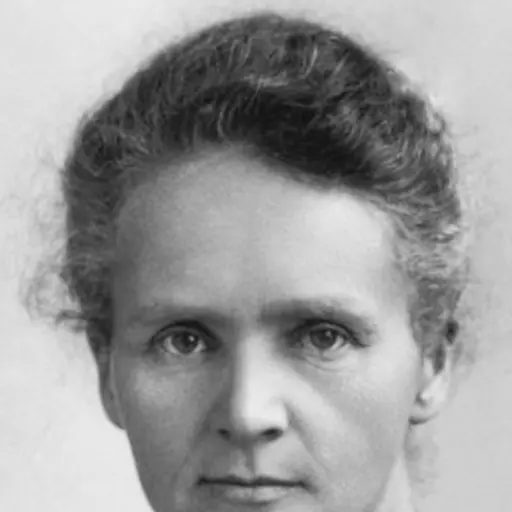

Discovered polonium and radium, won two Nobel Prizes and pioneered radioactivity research.
Life
From Warsaw to Paris
Maria Sklodowska was born in Warsaw, when Poland was ruled by Russia and women could not enter local universities. She saved for her tuition by working as a governess and in 1891 went to Paris to enter the Sorbonne, earning degrees in physics and mathematics with distinction; she married Pierre Curie and the two carried out research together.
Radioactivity research
Inspired by Becquerel's discovery, she systematically measured the rays from uranium salts, proposed that radioactivity is a property of the atom itself, and isolated polonium and radium from pitchblende. In 1903 she shared the Nobel Prize in Physics with Pierre and Becquerel, and in 1911 she won the Nobel Prize in Chemistry for the discovery of polonium and radium, becoming the first person to win the prize twice.
Battlefield and legacy
During World War I she developed mobile X-ray units and went to the front herself to help treat the wounded. She refused to patent the method of refining radium, holding that the results belonged to the scientific community. Long exposure to radioactive substances gave her aplastic anemia, from which she died. Her life also became an important symbol of women's entry into modern science.
Legacy
Marie Curie was one of the pioneers of radioactivity research, and her work laid the foundations for atomic physics, nuclear medicine and radiotherapy. She was the first woman to win a Nobel Prize and the only person to win in two different sciences. Her achievements in an academic world rife with gender prejudice made her an emblem of women in science. Because the dangers of radiation were poorly understood at the time, she and many of her colleagues damaged their health through long-term exposure to radioactive materials.
Major works & achievements
- Coined the term "radioactivity"
- Discovered polonium and radium
- Won two Nobel Prizes (Physics and Chemistry)
- Organized mobile X-ray units in World War I
- Founded the Radium Institute in Paris
Did you know? Her notebooks are still radioactive; anyone consulting them must wear protective gear and sign a liability waiver.
Key dates
- 1891Went to Paris to study at the Sorbonne
- 1895Married Pierre Curie
- 1898Discovered polonium and radium
- 1903Won the Nobel Prize in Physics
- 1906Pierre killed in an accident; she succeeds to his chair at the Sorbonne
- 1911Won the Nobel Prize in Chemistry
- 1914Organized battlefield X-ray units
- 1921Went to the US to raise funds for radium
- 1934Died of a radiation-related illness