Niels Bohr
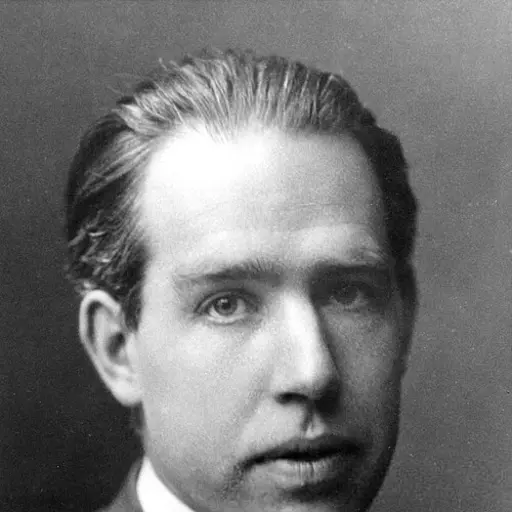

Proposed a quantized model of atomic structure and founded the Copenhagen school.
Life
Studied under Rutherford
Bohr was born in Copenhagen into a professor's family steeped in scholarship. He studied at the University of Copenhagen and then researched atomic structure at the Cavendish Laboratory in Britain and with Rutherford in Manchester. At the time, Rutherford's nuclear model of the atom could not explain why atoms are stable, nor why spectral lines appear as discrete lines.
Atomic model and school
In 1913 he proposed an atomic model in which electrons can move only in certain discrete orbits and jump between them only when absorbing or emitting energy, successfully explaining the hydrogen spectrum and becoming the core of the old quantum theory. He later founded the Institute for Theoretical Physics in Copenhagen, proposed the principle of complementarity, and with Heisenberg and others established the Copenhagen interpretation of quantum mechanics.
Wartime and postwar
During World War II he helped Jewish scientists escape Nazi-occupied territories, and later went to the United States to join the Manhattan Project; after the war he turned to calling for international control of nuclear weapons and openness of information. The Copenhagen interpretation long dominated physics teaching, but Einstein and others continued to question whether its probabilistic interpretation exhausted physical reality, a debate that continues unresolved to this day.
Legacy
Bohr's atomic model introduced quantum concepts into atomic structure and was a milestone of the old quantum theory. The Copenhagen institute he directed trained a generation of quantum physicists and became the center for the birth of quantum mechanics. His long-running debate with Einstein over the completeness of quantum mechanics is regarded as one of the most famous scholarly debates in the history of science. After the war he advocated scientific openness and international control of nuclear weapons; his proposals went unrealized during the Cold War but influenced later ideas of arms control.
Major works & achievements
- Proposed the Bohr atomic model in 1913
- Founded the Copenhagen Institute for Theoretical Physics
- Proposed the principle of complementarity
- Won the Nobel Prize in Physics in 1922
Did you know? His son Aage Bohr also won the Nobel Prize in Physics, in 1975.
Key dates
- 1911Went to the Cavendish Laboratory in Britain for further study
- 1912Moved to Manchester to work with Rutherford
- 1913Proposed a quantized model of atomic structure
- 1921Founded the Copenhagen institute
- 1922Won the Nobel Prize in Physics
- 1927Proposed the principle of complementarity
- 1943Fled Nazi-occupied Denmark
- 1950Wrote to the UN calling for nuclear openness
- 1962Died in Copenhagen