The world in 1571
1571, China: Ming (Longqing); India: Mughal Empire (Akbar); France: Valois dynasty (Charles IX); United Kingdom: Tudor dynasty (Elizabeth I). The main event that year: Longqing peace and tribute settlement.
1571: the table below lists the states and rulers of 45 regions of the world, followed by 14 events from around that year.
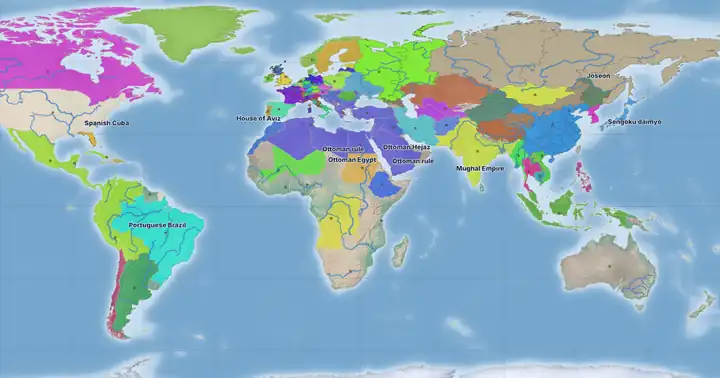
States and rulers by region
| Region | State or period | Ruler that year |
|---|---|---|
| United States | Native peoples · first Europeans arrive | — |
| United Kingdom | Tudor dynasty | Elizabeth I |
| France | Valois dynasty | Charles IX |
| Germany | Holy Roman Empire | Maximilian II |
| Rome | Spanish rule | — |
| Turkey | Ottoman Empire | Selim II |
| Egypt | Ottoman Egypt | — |
| Mesopotamia | Ottoman rule | — |
| Russia | Tsardom of Russia | Ivan IV |
| Scandinavia | Denmark–Norway · Sweden | — |
| India | Mughal Empire | Akbar |
| China | Ming | Longqing |
| Japan | Sengoku period | Ashikaga Yoshiaki |
| Greece | Ottoman rule | — |
| North Africa | Berber dynasties | Muhammad al-Shaykh (Saadi) |
| West Africa | Songhai Empire | Askia Daoud |
| Ethiopia | Solomonic dynasty | Sarsa Dengel |
| Sudan | Funj Sultanate | — |
| East Africa | Portuguese incursions | — |
| Central African Republic | Late Kingdom of Kongo · Atlantic slave trade | Álvaro I |
| Mexico | New Spain | — |
| Maya | Spanish conquest | — |
| Inca | Spanish conquest | Túpac Amaru (executed in 1572) |
| Mongolia | Tatars · Oirats | Altan Khan |
| Indonesia | Islamic sultanates | Trenggana of Demak |
| Spain | Habsburg dynasty | Philip II of Spain |
| Portugal | House of Aviz | Sebastian I |
| Thailand | Ayutthaya Kingdom | Maha Thammarachathirat (Toungoo vassal) |
| Vietnam | Mạc dynasty · Southern & Northern dynasties | Mạc Mậu Hợp (Northern Court) |
| Korean Peninsula | Joseon | Seonjo of Joseon |
| Iran | Safavid dynasty | — |
| Saudi Arabia | Ottoman Hejaz | Selim II |
| Uzbekistan | Shaybanid dynasty | Iskandar Khan |
| Poland | Polish–Lithuanian Commonwealth | Sigismund II Augustus |
| Netherlands | Habsburg Netherlands | Philip II of Spain (King of Spain) |
| Cambodia | Post-Angkor period | Barom Reachea I |
| Myanmar | Toungoo dynasty | Bayinnaung |
| Brazil | Portuguese Brazil | Mem de Sá (Governor-General) |
| Argentina | Spanish Río de la Plata | Irala (governor, based in Asunción) |
| Austria | Habsburg Monarchy | Maximilian II |
| Ireland | Tudor conquest | Elizabeth I |
| Afghanistan | Mughals & Safavids | Akbar |
| Caribbean | Spanish colonization | — |
| Baltic states | Sweden, Poland & Courland | — |
| Guyana | Europeans arrive | — |
The “Ruler that year” column comes from TimelineSurf's dated lists of rulers and heads of government. A blank means no record for that year, not that the region had no ruler. A few lists are incomplete, so the name may be the most recent one on record.
Events around this year
- 1569First fall of Ayutthaya
Bayinnaung besieged the city again and Ayutthaya fell; Toungoo installed Maha Thammaracha as king, and Siam remained a vassal for fifteen years. - 1569Union of Lublin
Poland and Lithuania signed an act of union at the Sejm of Lublin, forming the Commonwealth of Both Nations with a jointly elected king and a common Sejm; at the same time large parts of Ukraine were transferred to the Polish Crown. - 1570Rise of the sugar economy
Sugar plantations and mills multiplied rapidly in Pernambuco and Bahia, and the labor force gradually shifted from enslaved Indigenous people to slaves shipped from Africa; Brazil became the most important sugar producer in the world at the time. - 1570Queen Amina of Zazzau
According to Hausa tradition, Queen Amina of Zazzau (present-day Zaria) led armies on campaigns far and wide and built city walls in the 16th century; her story blends history and legend. - 1570Sultan Hairun of Ternate assassinated
Sultan Hairun of Ternate was killed in a Portuguese fortress; his son Babullah rose in revolt and in 1575 forced the Portuguese to withdraw from Ternate. - 1571Longqing peace and tribute settlement
Altan Khan concluded the Longqing peace with the Ming dynasty, was enfeoffed as Prince Shunyi, and border markets were opened; the Ming and the Mongols ended their wars and began to trade. - 1571Battle of Lepanto
The fleet of the Holy League of Spain, Venice and the Papacy inflicted a crushing defeat on the Ottoman fleet off Lepanto in Greece; Miguel de Cervantes lost the use of his left hand in the battle. - 1571Legazpi founds Manila
The Spaniard Legazpi captured Manila and made it the capital of the Spanish Philippines; thereafter the Manila galleons linked Asia and the Americas. - 1572Zhang Juzheng's reforms
Zhang Juzheng introduced the Single Whip Law and the Kaocheng performance-review system, bringing a brief restoration in the Ming era. - 1572St. Bartholomew's Day Massacre
Catholics in Paris carried out a mass massacre of Protestant Huguenots, intensifying the Wars of Religion. - 1572The Lusiads
Luís de Camões published the epic The Lusiads, which celebrates Portuguese history with Vasco da Gama's voyage as its main thread and became the founding work of Portuguese-language literature. - 1572Last Inca executed
Spain destroyed Vilcabamba and executed Túpac Amaru, the last Inca ruler. - 1572Sea Beggars capture Brielle
On April 1, rebel naval forces known as the "Sea Beggars" captured Brielle at the mouth of the Maas; the towns of Holland and Zeeland then went over to the revolt one after another, and the north became the rebellion's base from then on. - 1573Warsaw Confederation and free royal elections
The Sejm passed the Warsaw Confederation act, guaranteeing religious freedom for the nobility. In the same year a king was elected by the whole nobility for the first time, and the French prince Henry of Valois was chosen.