Luís de Camões
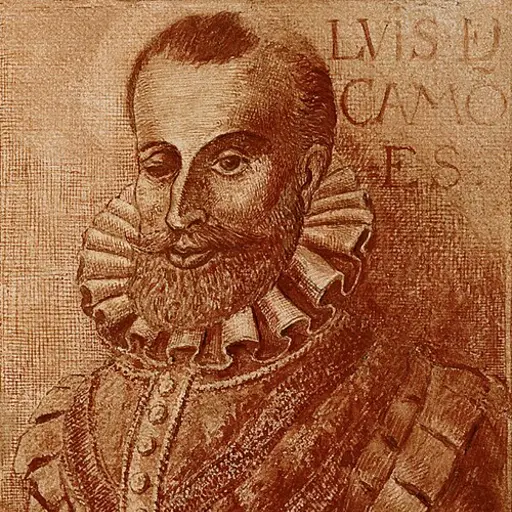

Author of the epic The Lusiads, revered as Portugal's greatest poet.
Life
One-eyed poet
Camões was born c. 1524, most likely in Lisbon, into a family of the declining minor nobility. He received a good humanist education, frequented the court in Lisbon as a young man and wrote lyric poetry. Around 1549 he served in Ceuta in North Africa, losing his right eye in battle; in 1552 he was jailed after a street brawl, and after his release the following year he was sent to serve in Asia.
Wanderings in the East
He lived in India and elsewhere in the East for about 17 years. He is said to have held a post in Macau and, when shipwrecked at the mouth of the Mekong, to have swum ashore saving his manuscript; these details come from his own verses and later biographies and are hard to verify fully. He lived in hardship in Mozambique and did not return to Lisbon until 1570. In 1572 he published the epic The Lusiads, which celebrates Portuguese history with Vasco da Gama's voyage as its central thread.
National poetic soul
King Sebastian granted him a small pension, but he remained poor in his last years. He died in Lisbon in 1580, just as the Portuguese royal line was dying out and the country was about to pass to the Spanish crown. His epic is regarded as the founding work of Portuguese-language literature, and the anniversary of his death, June 10, is still Portugal's national day.
Legacy
Luís de Camões is regarded as the greatest poet of the Portuguese language. The Lusiads fused Vasco da Gama's voyage and Portuguese history into a national epic, with a standing comparable to Dante's for Italian, and Portuguese has thus been called "the language of Camões." His lyric poetry was equally influential. Modern readers have also noted that the epic celebrates overseas expansion from a European perspective and that its depiction of other peoples bears the limitations of its time.
Major works & achievements
- Epic: The Lusiads
- Numerous sonnets and lyric poems
- Plays such as the comedy Amphitryon
Did you know? The Camões Prize, the highest award in Portuguese-language literature, is named after him and was jointly established by Portugal and Brazil.
Key dates
- 1524Born around this year
- 1549Serves in Ceuta around this time and loses his right eye
- 1553Released and sent to India
- 1556Said to have later held a post in Macau
- 1570Returns to Lisbon
- 1572Publishes The Lusiads
- 1580Died in Lisbon