William the Silent
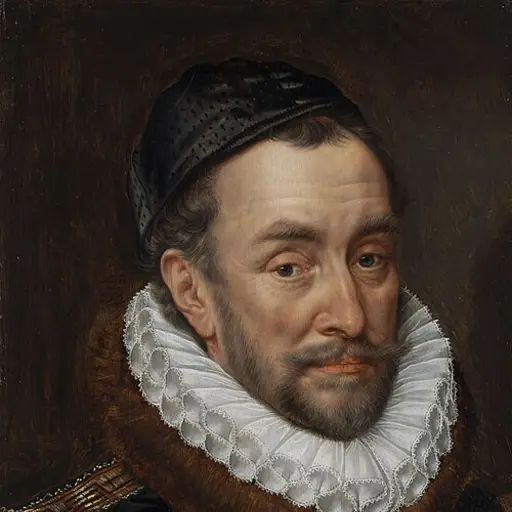

Led the revolt of the Netherlands against Spanish rule and is honored as the "Father of the Fatherland" of the Netherlands.
Life
Favorite of Charles V
William was born into the German House of Nassau. At age eleven he inherited from his cousin the Principality of Orange in southern France along with extensive lands in the Netherlands, and was immediately sent to the court of Charles V in Brussels to be educated as a Catholic. He enjoyed Charles V's deep trust; when Charles abdicated in Brussels in 1555, he is said to have walked to the podium leaning on the shoulder of the young William. After Philip II of Spain came to the throne, he appointed William stadtholder of Holland, Zeeland and Utrecht.
The Silent takes up arms
William opposed Philip II's policies of intensifying the persecution of Protestants and weakening the local nobility, and his political caution and reticence earned him the name "the Silent." He left the Netherlands before the Duke of Alba arrived with his army in 1567; the following year, after Egmont and Horn were executed, he rose in revolt, beginning the Eighty Years' War. His first few offensives all failed, and only in 1572, when the Sea Beggars captured Brielle and the towns of Holland and Zeeland went over to the revolt, did he gain a secure base. In 1574 he ordered the dikes breached to relieve Leiden, and the next year he founded Leiden University there. He himself later converted to Calvinism, but he advocated religious tolerance.
Assassinated Father of the Fatherland
William sought to unite the southern and northern provinces and brought about the Pacification of Ghent in 1576, but religious differences and conflicting interests gradually drove north and south apart. In 1580 Philip II declared him an outlaw and put a price on his head, and William responded with his Apology. The following year the northern provinces passed the Act of Abjuration, deposing Philip II. In July 1584 he was shot dead at his residence in Delft by the Catholic Balthasar Gérard. The Dutch national anthem, the "Wilhelmus," is written in his voice, and the Dutch national color, orange, also comes from the House of Orange.
Legacy
William is revered as the Father of the Fatherland of the Netherlands. The revolt he led ultimately brought about the independence of the Dutch Republic; the House of Orange repeatedly held the office of stadtholder thereafter and continues today as the Dutch royal family. In an age of fierce religious conflict he advocated tolerance, and his own faith changed several times, so he is regarded as a pragmatic statesman. The Spanish side long considered him a traitor; his assassination is thought to be one of the first killings of a national leader with a handgun in Europe.
Major works & achievements
- 1568: rose against Spain
- 1575: founded Leiden University
- Brought about the Pacification of Ghent, 1576
- Published the Apology refuting Philip II of Spain
Did you know? The Dutch national anthem, the "Wilhelmus," is considered one of the national anthems with the oldest lyrics in the world.
Key dates
- 1533Born in Dillenburg, Germany
- 1544Inherited the Principality of Orange and entered the court of Charles V
- 1559Became stadtholder of Holland, Zeeland and Utrecht
- 1568Rose in revolt against Spain; the Eighty Years' War begins
- 1572Sea Beggars capture Brielle, giving the revolt a base
- 1574Breached the dikes to relieve Leiden
- 1581Northern provinces passed the Act of Abjuration
- 1584Assassinated in Delft