Socrates
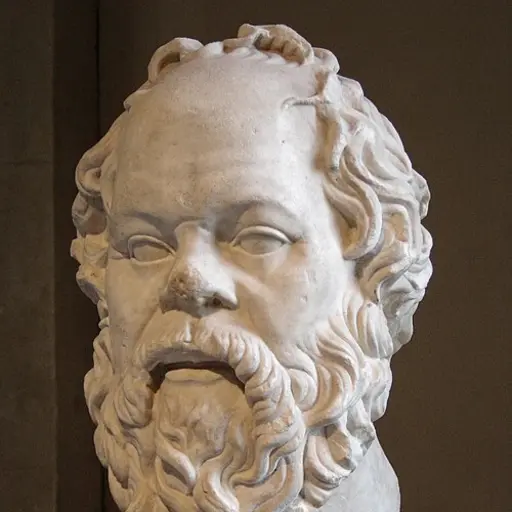

Probed virtue and knowledge through relentless questioning; sentenced to death on a charge of impiety.
Life
Son of a Stonemason
Socrates was born in Athens to a stonemason father and a midwife mother, and fought as a hoplite in the Peloponnesian War. The Athens of his day was sliding from imperial height into defeat and political turmoil; the Sophists taught rhetoric as a way to win arguments, while he insisted on asking what goodness and justice really are.
Questioning and Virtue
He founded no school and charged no fees, spending his days debating with people in the agora and exposing contradictions in their definitions through a chain of questions; he claimed to know only that he knew nothing. He turned philosophy from speculation about nature to ethics and human affairs, arguing that virtue is knowledge and that no one does wrong willingly; wrongdoing arises only from ignorance.
Trial and Hemlock
In 399 BCE he was charged with impiety toward the city's gods and with corrupting the young. Refusing to compromise before the jury court, he was sentenced to death and drank hemlock, forgoing the chance to escape. He left no writings of his own; his thought is known mainly through the accounts of Plato and Xenophon, and his trial became a classic case in debates over free speech and the city.
Legacy
Socrates is regarded as one of the founders of Western philosophy, which is why earlier philosophers are collectively called the "pre-Socratic philosophers." His conviction that "the unexamined life is not worth living" and his calm acceptance of death became symbols of intellectual independence. Since he wrote nothing himself, the portraits of Socrates by Plato, Xenophon, and Aristophanes differ, and the problem of reconstructing the real Socrates is known as the "Socratic problem."
Major works & achievements
- Pioneered the "Socratic method" of questioning
- Turned philosophy toward ethics and human affairs
- Held that "virtue is knowledge"
- Chose death rather than abandon his convictions
Did you know? According to Plato's Apology, the Oracle of Delphi declared that no one was wiser than Socrates, and he went about conversing with people to test the claim.
Key dates
- 432 BCEServes in the army at the Battle of Potidaea
- 424 BCECovers the retreat at the Battle of Delium
- 423 BCESatirized in the comedy The Clouds
- 406 BCEServed on the Council and opposed an unlawful trial
- 404 BCERefuses an arrest order from the Thirty Tyrants
- 403 BCEAthenian Democracy restored
- 399 BCEPut on trial, sentenced to death and died by drinking poison