Herodotus
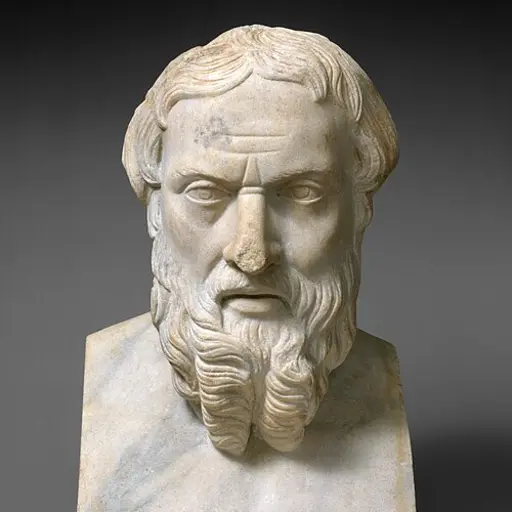

Traveled widely and wrote the Histories, founding the tradition of systematic historical writing.
Life
Homeland Under Persian Rule
Herodotus was born in Halicarnassus (modern Bodrum, Turkey), a Greek city-state on the southwest coast of Asia Minor that was then under the rule of the Persian Empire. His youth came shortly after the end of the Greco-Persian Wars, when Athens was using its maritime league to dominate the Greek world and the memory of the great eastern power of Persia was still fresh in every city-state.
Travels and History
To gather material he traveled to Egypt, Phoenicia, the shores of the Black Sea and even Mesopotamia, interviewing priests and elders and recording both what he saw and the legends he heard in his Histories, which systematically chronicled the causes and course of the Greco-Persian Wars and earned him the title "Father of History." In c. 443 BCE he joined an Athenian colonizing party to Thurii in southern Italy, where he settled in his later years and wrote until the work was complete.
Father of History
His writing often mixed in marvels based on hearsay, a habit his contemporary Thucydides already mocked obliquely; later scholars at one point derided him as the "Father of Lies," but modern archaeology and Egyptology have confirmed that many details of his accounts are well founded, and judgments of him have grown fairer—though his method was not rigorous, he founded the tradition of writing history by systematic inquiry and comparison of differing accounts.
Legacy
Cicero called Herodotus the "Father of History." He made "inquiry" his method of writing history, and while recounting war he described at length the customs, geography, and religion of many peoples, giving his Histories value as ethnography. His fondness for marvels has drawn much criticism, but it also preserved a great deal of otherwise lost oral tradition. Together with Thucydides, he established the two basic styles of Western historiography.
Major works & achievements
- The Histories in nine books
- Systematically chronicled the Greco-Persian Wars
- Recorded the customs of Egypt, Persia and other lands
Did you know? The Greek word in the title "Histories" originally meant "inquiry, investigation"; only later did it come to mean "history."
Key dates
- 484 BCEBorn in Halicarnassus, Asia Minor
- 454 BCETraveled in Egypt, Phoenicia and the Black Sea coast
- 447 BCEMoved to Athens and met Pericles
- 443 BCEJoined the colonists to Thurii in southern Italy
- 430 BCECompleted the Histories, an account of the Greco-Persian Wars
- 425 BCEDied in Thurii