José de San Martín
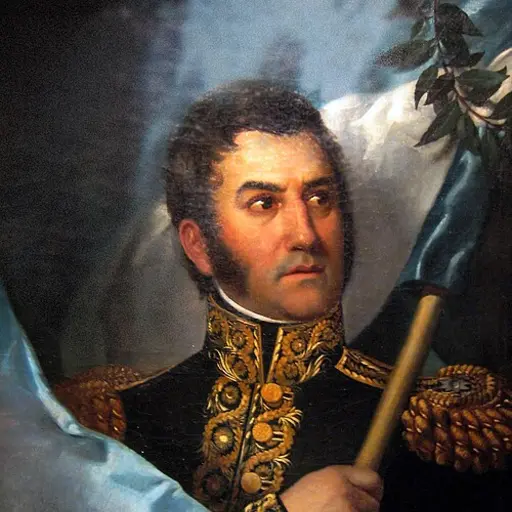

The "Liberator" who led the Army of the Andes over the mountains to free Chile and marched on Peru; the Father of the Fatherland of Argentina.
Life
Military service in Spain
San Martín was born in 1778 in Yapeyú, in the northeast of the Viceroyalty of the Río de la Plata; his father was a Spanish officer. As a child he returned to Spain with his family and joined the army in his youth, serving in the Spanish army for more than twenty years and fighting in North Africa, Portugal and France; in 1808 he distinguished himself against Napoleon's troops at the Battle of Bailén. In 1812 he resigned his Spanish commission, returned to Buenos Aires and formed the Regiment of Mounted Grenadiers, winning his first battle at San Lorenzo in 1813.
Crossing the Andes
Judging that an advance north through Upper Peru was unlikely to succeed, he became governor of Cuyo in 1814 and painstakingly built up the Army of the Andes in Mendoza. In early 1817 he led his army across the Andes in several columns and defeated the Spanish royal army at Chacabuco; in 1818 he won a decisive victory at Maipú, securing Chilean independence. He declined the post of Supreme Director of Chile, handing it to O'Higgins, and set about organizing an army for an expedition to Peru.
Peru and retirement
In 1820 he led a combined Chilean-Argentine expeditionary force north by sea, and in 1821 he entered Lima, proclaimed the independence of Peru and became its "Protector." In 1822 he met Bolívar secretly at Guayaquil, then resigned all his posts, leaving the final campaigns to Bolívar. Unwilling to be drawn into the civil wars of the Río de la Plata, he lived in Europe from 1824 and died in Boulogne-sur-Mer, France, in 1850; his remains were later moved to the cathedral of Buenos Aires.
Legacy
San Martín and Bolívar are ranked as the two great leaders of the South American wars of independence. His expedition across the Andes is regarded as a feat of military history, and he helped bring about the independence of Argentina, Chile and Peru in turn; Argentina reveres him as the Father of the Fatherland. After the Guayaquil Conference he voluntarily withdrew and refused to be drawn into civil war, and is admired for his indifference to power. His leaning toward constitutional monarchy at one point in his later years is less often mentioned.
Major works & achievements
- Formed the Regiment of Mounted Grenadiers
- Led the Army of the Andes across the Andes
- Victories at Chacabuco and Maipú
- Proclaimed the independence of Peru
Did you know? Argentina observes the anniversary of his death, August 17, as a national holiday in his memory.
Key dates
- 1778Born in Yapeyú
- 1808Fought at the Battle of Bailén in the Spanish army
- 1812Returned to Buenos Aires and formed the Regiment of Mounted Grenadiers
- 1814Became governor of Cuyo and built up the Army of the Andes
- 1817Crossed the Andes; great victory at Chacabuco
- 1818Battle of Maipú secured Chile's independence
- 1821Proclaimed the independence of Peru and became Protector
- 1822Withdrew from public life after the Guayaquil Conference
- 1850Died in Boulogne-sur-Mer, France