Simón Bolívar
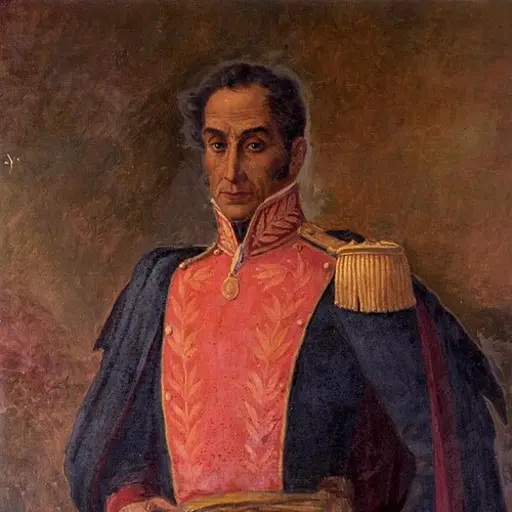

Led armies that liberated several South American nations; revered as "the Liberator."
Life
Creole aristocrat
Born into a Creole aristocrat family in Caracas, Bolívar traveled in Europe as a young man and was deeply influenced by Enlightenment thought. Back in Venezuela, he threw himself into the movement of resistance against Spanish colonial rule. At the time, Napoleon's invasion of Spain itself had weakened Spain's hold on its American colonies, and independence movements were springing up everywhere.
Liberating northern South America
He led his army across the Andes in a surprise attack on New Granada, won a great victory over the Spanish army at the Battle of Boyacá in 1819, and then brought about the founding of the Republic of Colombia (Gran Colombia). He went on to liberate Ecuador, Peru and Upper Peru (later renamed Bolivia in his honor), and sought to unite these newly independent states into a single South American federation.
Federal dream shattered
He is revered across Latin America as "the Liberator," and currencies and place names in several countries bear his name. But in his last years, as separatism spread through Gran Colombia, he was deserted by all and died in despair, and his vision of a united South American state was never realized. Since then various political forces in Latin America have often invoked his name to legitimize themselves, so his historical image has repeatedly been put to political use.
Legacy
Bolívar led Venezuela, Colombia, Ecuador, Peru and Bolivia to independence and is honored across Latin America as "the Liberator"; Bolivia is named after him. His vision of Latin American unity remains influential to this day. In his later years, however, he advocated strong centralization and a president-for-life system, drawing criticism from republicans; Gran Colombia broke apart around the time of his death, and his vision of unity was never realized.
Major works & achievements
- Great victory at the Battle of Boyacá in 1819
- Founded the Republic of Gran Colombia
- Liberates Ecuador, Peru and Upper Peru
- Convened the Congress of Panama
Key dates
- 1810Returns to Venezuela to join the independence movement
- 1813Enters Caracas and receives an honorific title
- 1819Crosses the Andes to victory
- 1819Republic of Gran Colombia founded
- 1822Liberates Ecuador
- 1824Battle of Ayacucho ends Spanish rule
- 1825Upper Peru renamed Bolivia
- 1830Died in Santa Marta