Bernardo O'Higgins
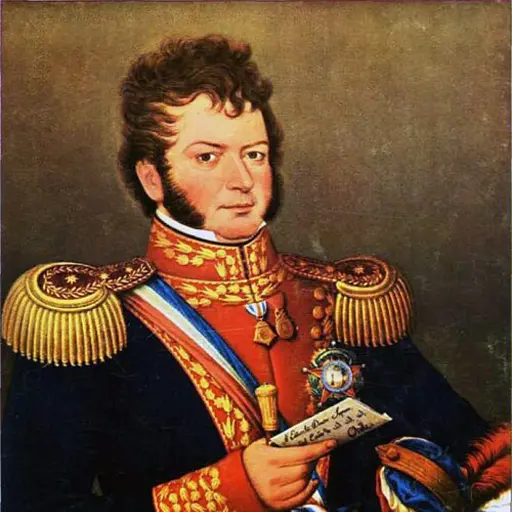

Leader of Chilean independence and first Supreme Director, revered as the Father of the Fatherland of Chile.
Life
Born in Chillán
O'Higgins was born in 1778 in Chillán in southern Chile, the illegitimate son of Ambrosio O'Higgins, a Spanish official of Irish descent who later became governor of Chile and Viceroy of Peru. As a youth he was sent to study in Lima and Europe; in Britain he met Miranda, the pioneer of Venezuelan independence, and embraced the idea of independence. After his father's death he returned to Chile to manage the estate he had inherited.
Battlefield and independence
After Chile set up a governing junta in 1810, he joined the patriot camp and became one of its military commanders. After the defeat at the Battle of Rancagua in 1814 and the restoration of Spanish rule in Chile, he fled with the remnants of his force over the mountains to Mendoza and joined San Martín's Army of the Andes. After the Battle of Chacabuco in 1817 he became Supreme Director of Chile, and in February 1818 he proclaimed Chilean independence; in March of that year he was wounded at the Battle of Cancha Rayada, yet in April he still hurried to the battlefield of Maipú.
Rule and exile
In office he founded the Chilean navy to support San Martín's expedition to Peru and carried out reforms such as abolishing titles of nobility and founding schools, but his centralizing style and reforms threatened the interests of the nobility, the Church and local powers. In January 1823, under pressure from all sides, he resigned and went into exile in Peru; he died in Lima in 1842 and never returned to Chile.
Legacy
O'Higgins was the central leader of Chilean independence and Chile's first head of state, revered as the Father of the Fatherland of Chile. Working with San Martín, he completed Chile's liberation and then built a navy to support Peru's independence. While in power he carried out a number of modernizing reforms, but his centralizing style and persecution of political rivals also caused discontent, and he was eventually forced out and died in exile. His image in Chile is lofty overall, though historians often mention his autocratic side as well.
Major works & achievements
- Fought in the Chilean War of Independence
- Proclaimed Chile's independence in 1818
- Founded the Chilean navy
- Pushed reforms such as abolishing noble titles
Did you know? Santiago's main avenue is named after him: the Avenida Libertador General Bernardo O'Higgins (Liberator General Bernardo O'Higgins Avenue).
Key dates
- 1778Born in Chillán
- 1810Joined the Chilean independence movement
- 1814Defeated at the Battle of Rancagua; exile in Mendoza
- 1817Became Supreme Director after the Battle of Chacabuco
- 1818Proclaimed Chilean independence; Battle of Maipú
- 1823Resigned; exile in Peru
- 1842Died in Lima