Ban Zhao
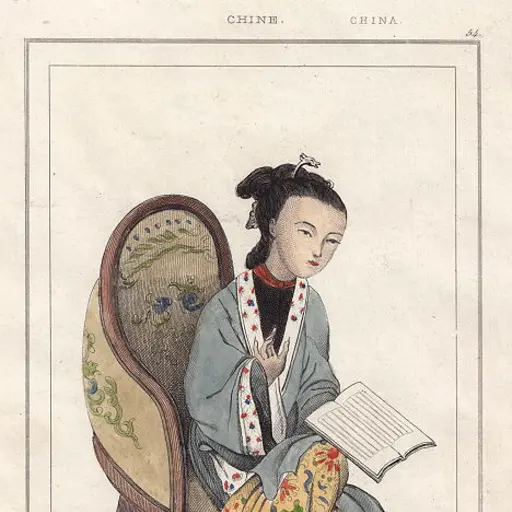

Completed her elder brother's unfinished Book of Han and also served as a tutor to women at court.
Life
Family of historians
Ban Zhao was born into the Ban family of historians in Fufeng; her father Ban Biao and elder brother Ban Gu were both famous for writing history. She read widely from childhood, was widowed soon after marrying young, and devoted most of the rest of her life to learning and writing.
Completed the Book of Han
Her elder brother Ban Gu died in prison after being implicated in the Dou Xian affair, leaving the eight tables and the treatise on astronomy of his Book of Han unfinished. Emperor He of Han summoned her to the palace by decree to continue and complete it, so that this biographical-annalistic dynastic history was finally finished. She also long served as an adviser during Empress Dowager Deng's regency and as a teacher to the women of the palace, taking part in court deliberations.
Admonitions for Women and controversy
In her later years she wrote "Admonitions for Women," which taught women to be humble, yielding and meek and to regard the husband as their guiding principle. Later rulers honored the book as a classic of women's education, and it was repeatedly printed and circulated. Some scholars have pointed out, however, that Ban Zhao, who wrote these admonitions, was herself one of the very few women scholars of her time able to continue an official history and take part in government, and that there is a clear contrast between her own conduct and the "womanly virtue" she advocated; this contradiction remains an unavoidable topic in assessing her to this day.
Legacy
Ban Zhao is the first woman historian in Chinese history whose name is known. She completed the Book of Han and taught its contents, contributing greatly to the completion and transmission of this dynastic history. Her Admonitions for Women preached "humility and weakness" and "respect and compliance"; later it was included among the "Four Books for Women" and became a canonical text of ritual teaching that constrained women, and it has been widely criticized in modern times. Some scholars argue, however, that given the perilous environment of the Eastern Han court, the book reflects practical concerns for self-preservation and should not be judged simply out of its historical context.
Major works & achievements
- By imperial order, completed the eight Tables and the Treatise on Astronomy of the Book of Han
- Wrote Admonitions for Women in seven chapters
- Wrote the Rhapsody on the Eastern Journey
- Taught the empress and palace consorts at court, and was called "Cao Dagu"
Did you know? When the Book of Han was first completed its language was so difficult that, according to records, the renowned scholar Ma Rong sat beneath the Dongguan library to be taught how to read it by Ban Zhao.
Key dates
- 45Born into the Ban family of historians in Fufeng
- 79Married Cao Shishu; widowed early and remained chaste
- 92Her brother Ban Gu died in prison, leaving the Book of Han unfinished
- 96Summoned to the palace to complete the Book of Han
- 106Empress Dowager Deng's regency; served as tutor to the imperial women
- 110Wrote Admonitions for Women to instruct palace women
- 116Died