Trajan
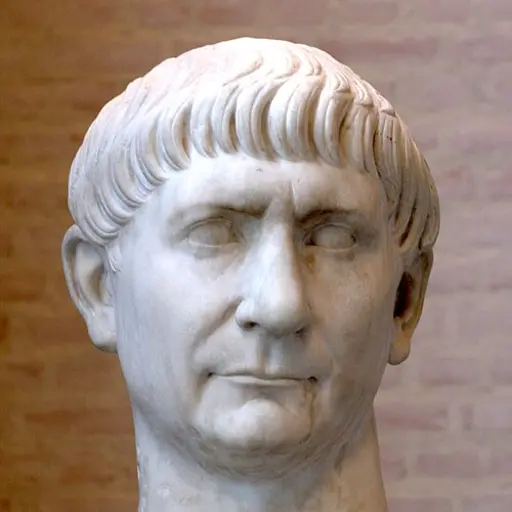

The first provincial-born emperor, who pushed the empire's territory to its greatest extent.
Life
Provincial-born
Trajan was born in Italica in the Roman province of Spain and was the first Roman emperor from the provinces rather than from Italy itself. In his early years he long commanded troops on the Rhine and Danube frontiers and knew military affairs thoroughly. Before his accession the expansion of the Roman Empire had slowed, yet pressure on its borders kept growing.
Expanded the frontiers
In 98 CE he succeeded his adoptive father Nerva as emperor, then twice campaigned against Dacia north of the Danube; in 106 CE he destroyed the Kingdom of Dacia and annexed it, using the gold of the spoils to build Trajan's Forum and Column. Late in life he marched east against Parthia, for a time capturing its capital Ctesiphon and reaching the Persian Gulf, bringing the Roman Empire to its greatest territorial extent in history.
Best of Princes
The Senate granted him the title "Best of Princes," and later generations often held him up as the model of an ideal monarch, counting him with successors such as Hadrian among the "Five Good Emperors." But his late conquests in Mesopotamia soon proved impossible to hold because of local revolts and Persian counterattacks, and his successor Hadrian abandoned almost all of these newly occupied lands, showing that his eastern campaign, however brilliant militarily, was not necessarily sound strategically.
Legacy
Under Trajan the Roman Empire reached its greatest territorial extent. Through military victories, public works and respect for the Senate he earned the name "Best of Princes" (Optimus Princeps), and it is recorded that the later Senate, when praying for a new emperor, often wished that he be "luckier than Augustus and better than Trajan." The spiral reliefs of his column are a precious visual source for the study of the Roman army. But his eastern expansion came at a heavy cost, and his successor Hadrian promptly abandoned the newly occupied Mesopotamia, prompting later reflection on his strategy.
Major works & achievements
- Conquered Dacia and made it a province
- Campaigned east against Parthia and captured Ctesiphon
- Built Trajan's Forum and Column
- Expanded aid for poor and orphaned children
Did you know? The Latin roots of Romania's name and language are often traced to the Romanization that followed Trajan's conquest of Dacia.
Key dates
- 53Born in Italica, Spain
- 91Governor of Germania
- 98Succeeded Nerva as emperor
- 101First Dacian War
- 106Annexed Dacia, filling the imperial treasury
- 113Launched the Parthian War
- 116Captured Ctesiphon and reached the Persian Gulf
- 117Died of illness on the way home