The world in 1925
1925, China: Republic of China (Li Yuanhong); Mesopotamia: Kingdom of Iraq (Faisal I); Iran: Pahlavi dynasty (Reza Shah); India: Independence movement (Reading). The main event that year: Pahlavi dynasty founded.
1925: the table below lists the states and rulers of 50 regions of the world, followed by 14 events from around that year.
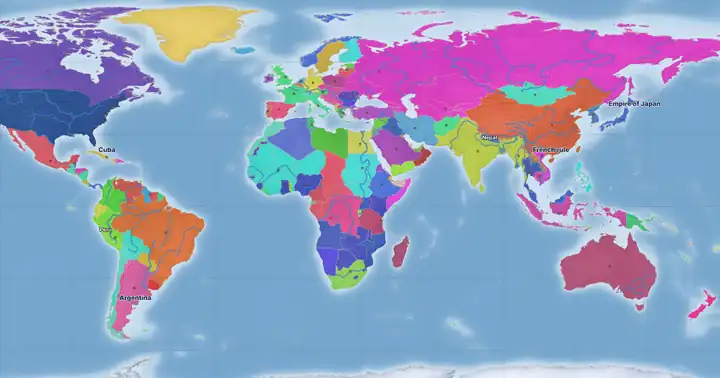
States and rulers by region
| Region | State or period | Ruler that year |
|---|---|---|
| United States | United States of America | Coolidge |
| United Kingdom | United Kingdom | MacDonald |
| France | French Republic | Poincaré |
| Germany | Weimar Republic | Hindenburg |
| Rome | Fascist Italy | Mussolini (Prime Minister) |
| Turkey | Republic of Turkey | Atatürk |
| Egypt | British occupation & Kingdom of Egypt | Fuad I |
| Mesopotamia | Kingdom of Iraq | Faisal I |
| Russia | Soviet Union | Stalin |
| Scandinavia | Sweden · Norway · Denmark | Haakon VII (Norway) |
| India | Independence movement | Reading |
| China | Republic of China | Li Yuanhong |
| Japan | Taishō era | Kato Takaaki |
| Greece | Republics and monarchies alternate | Venizelos (Second Republic) |
| North Africa | French North Africa | Abd el-Krim (Rif) |
| West Africa | French West Africa | — |
| Ethiopia | Solomonic dynasty | Empress Zewditu |
| Sudan | Anglo-Egyptian Sudan | Lee Stack (governor) |
| East Africa | German & British East Africa | Donald Cameron (Governor of Tanganyika) |
| Central African Republic | Congo Free State | Albert I (King of the Belgians) |
| South Africa | Union of South Africa | Hertzog |
| Nigeria | British Nigeria | Graeme Thomson |
| Ghana | British Gold Coast | Guggisberg |
| Mexico | Institutional revolution | Plutarco Calles |
| Maya | Guatemala · Honduras · Belize | — |
| Inca | Peru · Bolivia · Ecuador | — |
| Mongolia | Mongolian People’s Republic | — |
| Indonesia | Dutch East Indies | — |
| Australia | Commonwealth of Australia | Bruce |
| Spain | Restoration | Primo de Rivera (dictator, under King Alfonso XIII) |
| Portugal | First Republic | Machado (president) |
| Thailand | Chakri dynasty | Rama VII Prajadhipok |
| Vietnam | French rule | Emperor Khải Định, Nguyễn Phúc Bửu Đảo (Nguyễn dynasty nominal emperor) |
| Korean Peninsula | Japanese colonial rule | Saito Makoto (Japanese Governor-General of Korea) |
| Iran | Pahlavi dynasty | Reza Shah |
| Saudi Arabia | Third Saudi State | Abdulaziz (Sultan of Najd) |
| Uzbekistan | Soviet era | Fayzulla Khodjayev (Chairman of the Uzbek Council of People's Commissars) |
| Poland | Second Polish Republic | Wojciechowski (President) |
| Netherlands | Kingdom of the Netherlands | Wilhelmina (personal rule) |
| Cambodia | French protectorate | Sisowath |
| Myanmar | British Burma | Burma Province (governor, dyarchy) |
| Brazil | Old Republic | Artur Bernardes |
| Argentina | Radical governments | Alvear |
| Canada | Dominion of Canada | Mackenzie King |
| Austria | First Republic | Rudolf Ramek |
| Ireland | Irish Free State | W. T. Cosgrave |
| Afghanistan | Kingdom of Afghanistan | Amanullah |
| Caribbean | US influence | — |
| Baltic states | Independence & first republics | — |
| Guyana | Late colonial period | — |
The “Ruler that year” column comes from TimelineSurf's dated lists of rulers and heads of government. A blank means no record for that year, not that the region had no ruler. A few lists are incomplete, so the name may be the most recent one on record.
Events around this year
- 1923Joins the League of Nations
Ethiopia became a member of the League of Nations, one of the few independent African states recognized at the time. - 1924First United Front
The Kuomintang reorganized, adopting alliance with the Soviet Union and admission of Communists, and founded the Whampoa Military Academy; the Nationalists and Communists joined hands in revolution. - 1924Mongolian People’s Republic
After the Jebtsundamba died, the monarchy was abolished and the Mongolian People's Republic was founded, taking the socialist path. - 1924National delimitation in Central Asia
The Soviet Union drew Central Asia's administrative boundaries along ethnic lines, creating the Uzbek and Turkmen union republics, followed later by the Tajik, Kazakh and Kyrgyz union republics. - 1924Return of Prempeh I
Prempeh I, after nearly thirty years in exile, was allowed to return to Kumasi; in 1926 he was recognized as Kumasihene, and in 1935 the Ashanti Confederacy was restored. - 1925Pahlavi dynasty founded
The National Assembly deposed the Qajar dynasty and Reza Khan was enthroned as Reza Shah, introducing conscription, building railways, setting up modern schools and reforming clothing. - 1925Ibn Saud takes the Hejaz
In 1924 the Saudi army entered Mecca, and at the end of 1925 Jeddah surrendered, ending the Hashemite Kingdom of the Hejaz; the following year Ibn Saud was proclaimed King of the Hejaz in Mecca. - 1925Gezira Scheme
The Sennar Dam was completed, and large-scale irrigated cotton cultivation began on the Gezira plain between the Blue and White Niles, becoming the mainstay of the colonial economy. - 1925Universal Suffrage Law and Peace Preservation Law
Japan introduced universal suffrage for men aged 25 and over, while at the same time enacting the Peace Preservation Law to suppress social movements. - 1926Northern Expedition
The National Revolutionary Army set out from Guangdong and pushed north to fight the Beiyang warlords, advancing national unification. - 192628 May coup
Gomes da Costa and other generals staged a coup that overthrew the First Republic and established a military dictatorship, paving the way for Salazar's rise to power. - 1926Germany joins the League of Nations
At the urging of Foreign Minister Stresemann, Germany signed the Locarno Treaties and then joined the League of Nations, bringing a brief thaw in Weimar diplomacy. - 1926Cristero War
The Calles government strictly enforced the anticlerical articles of the Constitution, and Catholics in west-central Mexico rose in armed revolt; the war lasted until 1929. - 1926Lithuanian coup
The military staged a coup and Smetona became President, setting Lithuania on the path to authoritarian rule.