Mohandas Gandhi
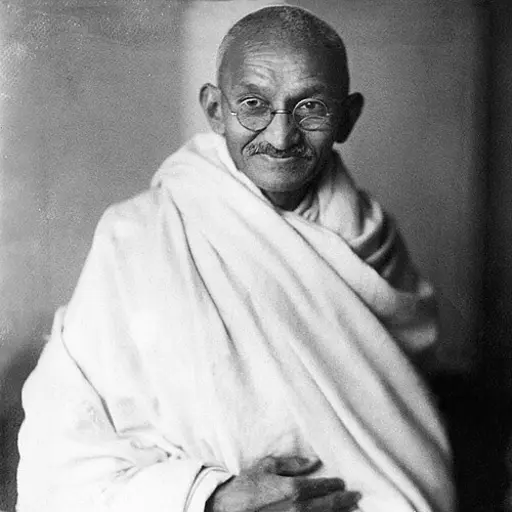

Drove India's independence through nonviolent non-cooperation, inspiring civil rights movements around the world.
Life
Awakening in South Africa
Gandhi came from a merchant-caste family in Gujarat. After studying law in London he went to practice in South Africa. There he experienced racial discrimination firsthand and organized the Indian community's resistance for more than twenty years, developing his philosophy of nonviolent non-cooperation centered on satyagraha ("truth-force"). In 1915 he returned to India under British rule.
Nonviolent movement
He transformed the Indian National Congress into a mass organization, promoted homespun cloth and the boycott of British goods, and launched the Non-cooperation movement and the Civil Disobedience movement. In 1930 he walked more than 300 kilometers to the sea to make salt in protest against the salt monopoly, sparking a nationwide response and mass arrests and drawing wide international attention to the demand for independence.
Independence and assassination
He also worked to improve the status of the untouchables and to reconcile Hindus and Muslims, fasting several times to stop sectarian killings. India's independence in 1947 came together with the Partition of India and massive bloodshed, and the following year he was assassinated by a Hindu extremist. His nonviolent methods were later widely adopted by civil rights movements around the world, while his views on caste and social issues remain debated.
Legacy
Gandhi mobilized every stratum of Indian society through nonviolent mass movements, giving the independence movement unprecedented breadth and moral force. He is revered as the "Mahatma" and as India's "Father of the Nation," and his methods deeply influenced the Civil Rights Movement in the United States and the anti-apartheid struggle in South Africa. Critics argue that his stance on the caste system was rather conservative; he clashed sharply with Ambedkar over the rights of the untouchables, and his early remarks about Africans in South Africa have also been questioned.
Major works & achievements
- Developed satyagraha ("truth-force"), a philosophy of nonviolent resistance
- Led the Non-cooperation movement
- Launched the Salt March in 1930
- Launched the Quit India movement
- Autobiography The Story of My Experiments with Truth
Did you know? His birthday, October 2, has been designated by the United Nations as the "International Day of Non-Violence."
Key dates
- 1893Practices law in South Africa; encounters racial discrimination
- 1906Launched nonviolent resistance in South Africa
- 1915Returned to India
- 1919Protests the Rowlatt Act; launches a nationwide campaign
- 1920Led the Non-cooperation movement
- 1930Led the Salt March
- 1942Launched the Quit India Movement
- 1947India's independence and the Partition of India
- 1948Assassinated