Abdulaziz Ibn Saud
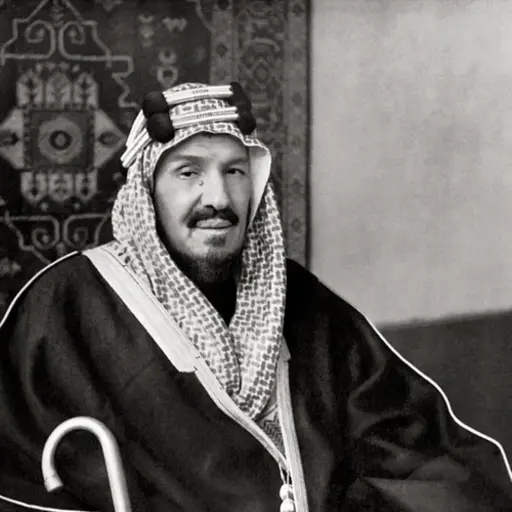

Unified most of the Arabian Peninsula and founded the Kingdom of Saudi Arabia.
Life
Retaking Riyadh
Ibn Saud was born into the House of Saud in Najd, and as a child went into exile in Kuwait with his family after it lost power in tribal warfare. In 1902, with only a few dozen followers, he launched a night raid on Riyadh and recaptured his ancestors' lost capital. Over the following decades, combining marriage alliances with religious appeals, he gradually conquered the many tribes and emirates of Najd, the Hejaz and elsewhere.
Unifying and founding the state
He expanded his power with the help of a religious militia known as the "Ikhwan," defeating in turn the House of Rashid and the Hashemites of the Hejaz, and in 1932 merged his conquered lands into the unified Kingdom of Saudi Arabia, with himself as king. In 1938 an American oil company discovered large oil fields in his territory, and oil revenue soon transformed a country whose economy had until then rested mainly on nomadic herding and the pilgrimage to Mecca.
Dynasty and controversy
The Saudi royal family's narrative reveres him as the founding father, and his descendants still rule the country today. Late in life, however, he did not hesitate to take up arms against the Ikhwan movement, which had grown so radical that it no longer accepted even his authority, and he governed by strict religious law; Western media and some Islamic scholars have always been sharply divided over his model of rule uniting religion and state.
Legacy
Ibn Saud unified most of the Arabian Peninsula under a single kingdom, ending a long period of tribal fragmentation, and is regarded as the founder of the state of Saudi Arabia; the oil era he ushered in utterly transformed the country and the regional order. He built the state through a combination of tribal marriage alliances, religious alliance and military force, establishing a political model of joint rule by the royal family and the religious scholars. This model brought stability but has long been controversial because of the relationship between religion and state and the extreme concentration of power.
Major works & achievements
- Retook Riyadh in 1902
- Conquered the Hejaz, taking control of Mecca and Medina
- Founded the Kingdom of Saudi Arabia in 1932
- Granted oil concessions to an American company
Did you know? He fathered dozens of children in his lifetime, and several later kings of Saudi Arabia were his sons.
Key dates
- 1902Retakes Riyadh in a night raid
- 1913Captures the al-Hasa oasis
- 1921Defeats the House of Rashid
- 1925Captures the Hejaz, takes control of Mecca and Medina
- 1929Crushes the Ikhwan revolt
- 1932Founds the Kingdom of Saudi Arabia
- 1938Vast oil reserves discovered in the country
- 1953Died in Taif