Mustafa Kemal Atatürk
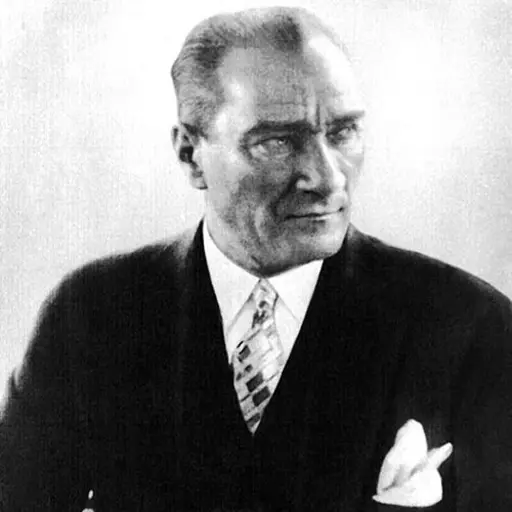

Led the War of Independence, founded the Republic and carried out secularizing reforms.
Life
Hero of Gallipoli
Atatürk was born in Ottoman-ruled Salonica. After attending military schools he joined the reform movement of the Young Turks. In World War I he led troops in successfully repelling the Anglo-French landings in the Gallipoli campaign, making his name and becoming one of the few generals in the defeated Ottoman Empire who retained military prestige.
Founding the state through the War of Independence
After the war, when the Allies planned to partition Anatolia, he convened a National Assembly in Ankara to organize resistance and led the Turkish War of Independence, driving back the Greek army. In 1922 he abolished the sultanate, and in 1923 he proclaimed the Republic of Turkey and became its first President. He then carried out a series of secularizing reforms: abolishing the caliphate, adopting the Latin alphabet, granting women's suffrage and adopting a Western-style civil code.
Secularizing reforms
The Turkish state and most of its citizens revere him as the "Father of the Fatherland," and his secular republican system has long been the core of national identity. But his radical secularizing reforms also suppressed the demands of religious conservatives, and his policies suppressing the cultures of Kurds and other minorities in the course of building the nation-state remain a sensitive issue in Turkish politics to this day.
Legacy
Atatürk led Turkey in resisting partition after its defeat in World War I and in building a nation-state, and drove the country's modernization through secularization, legal reform and educational reform. He is revered by Turks as the "Father of the Nation," and Kemalism long served as Turkey's founding principle. Critics point out that his reforms were imposed from the top down in an authoritarian manner, suppressing the demands of religious conservatives and of minorities such as the Kurds, issues that still echo in contemporary Turkish politics.
Major works & achievements
- Held the line at Gallipoli
- Led the Turkish War of Independence
- Founded the Republic of Turkey in 1923
- Abolished the caliphate
- Introduced the Latin alphabet reform
Did you know? "Atatürk" means "Father of the Turks"; it was the surname the parliament conferred on him in 1934.
Key dates
- 1915Leads troops to victory at Gallipoli
- 1919Launches the Turkish War of Independence
- 1920Convenes the Grand National Assembly in Ankara
- 1922Abolishes the sultanate
- 1923Republic established; elected President
- 1928Adopts the Latin alphabet
- 1934Surname Law enacted; receives an honorific surname
- 1938Died in Istanbul