Sun Tzu
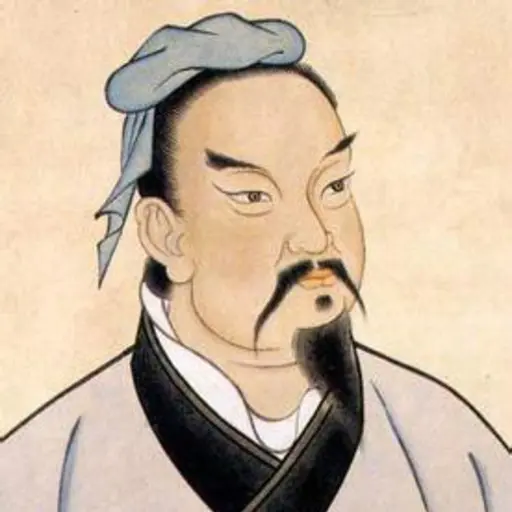

Wrote The Art of War, laying the foundation of military theory in East Asia.
Life
Meeting Helü in Wu
Sun Tzu came from the Tian clan of the State of Qi and later took refuge in the State of Wu because of internal strife. In the late Spring and Autumn period, Wu was rising with the help of Wu Zixu and contending with the State of Chu for the Yangtze–Huai region, urgently needing able commanders. He presented his thirteen chapters on the art of war to King Helu of Wu and, according to legend, established his authority by drilling palace women in battle formation, after which he was appointed general.
Defeating Chu at Boju
In 506 BCE the Wu army advanced west along the Huai River; Sun Tzu and Wu Zixu led the Wu forces to victory in five battles out of five, crushing the Chu army at Boju and for a time taking the Chu capital, Ying. His military thought held that one should plan before fighting and win at the least cost, stressed knowing the enemy and knowing oneself and adapting to the enemy's changes, and opposed drawn-out wars of attrition.
Legacy of The Art of War
Concise in language and complete as a system, The Art of War is the earliest surviving systematic military treatise. From the Warring States period on it was required reading for commanders; after the Tang and Song it spread to Japan and Korea, and in modern times it has been translated into many languages and widely applied beyond the military, in business and negotiation. Little is known of Sun Tzu's own later life.
Legacy
Sun Tzu was revered by later generations as the "Sage of War," and his ideas, such as "Know the enemy and know yourself, and in a hundred battles you will never be in peril" and "subduing the enemy without fighting," are still widely quoted today. The Art of War was introduced to Europe by a French missionary in the 18th century and has since spread around the world. Because the Zuo Zhuan does not mention Sun Tzu, from the Song dynasty onward some doubted both the man and the book, a controversy largely settled only by the discovery of the Yinqueshan Han bamboo slips in 1972.
Major works & achievements
- The 13 chapters of The Art of War
- Crushed Chu at the Battle of Boju
- Served King Helü of Wu alongside Wu Zixu
Did you know? Bamboo slips of both The Art of War and Sun Bin's Art of War were unearthed together from the Han tombs at Yinqueshan, proving that they are two separate military treatises.
Key dates
- 515 BCEFlees turmoil in Qi for Wu
- 512 BCEPresents his 13-chapter Art of War to King Helü of Wu
- 511 BCEDevises with Wu Zixu a strategy to wear down Chu
- 506 BCECrushed Chu at the Battle of Boju
- 505 BCEQin and Chu counterattacked; the Wu army withdrew from Ying
- 496 BCEWu and Yue went to war; his deeds faded from the record
- 470 BCESaid to have died in Wu