Laozi
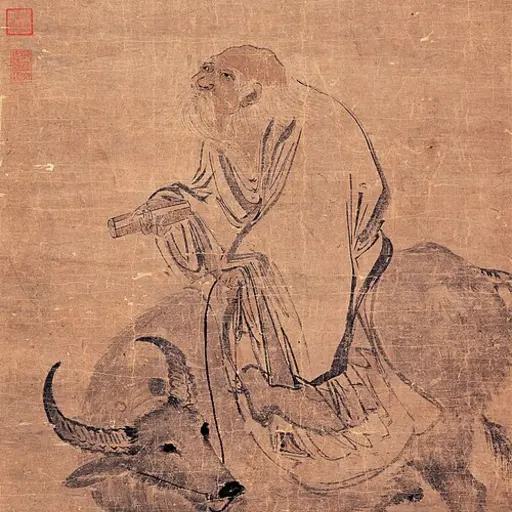

Founder of Daoist thought; the Tao Te Ching teaches that the Dao follows nature.
Life
Archivist of the Zhou Court
Laozi is said to have been surnamed Li with the given name Er, a native of Ku County in the State of Chu, and to have served as keeper of the archives for the Zhou royal court, in charge of its books and records. He lived in the late Spring and Autumn period, when the Zhou royal house was in decline, the lords contended for hegemony and the old ritual system could hardly be sustained; scholars began reflecting on the source of order and the proper way to govern, and Daoism took shape in this setting.
Writing a Book on Leaving West
According to the Records of the Grand Historian, Confucius once asked him about ritual; later, seeing the Zhou house decline day by day, he went west through a mountain pass and, at the request of the pass keeper, left behind a text of 5,000 characters, the Tao Te Ching. The book takes the Dao as the origin of all things and advocates governing by non-action, holds that the soft overcomes the hard, calls for abandoning sagehood and discarding cleverness, and opposes elaborate rituals and laws and frequent wars.
The Man and the Book
The records of Laozi's life are sparse, and the dates of his birth and death and of his work have long been disputed; most scholars believe the Tao Te Ching took shape through long accumulation. His thought complements Confucianism, and together they form the two great sources of Chinese thought; later the Daoist religion revered him as its founder, and his ideas of naturalness and restraint spread throughout East Asia.
Legacy
Laozi is revered as the founder of the Daoist school and paired with Zhuangzi as "Lao-Zhuang"; his thought and Confucianism are the two main pillars of traditional Chinese thought. From the Eastern Han onward, the Daoist religion worshiped him as Taishang Laojun, and the Tang dynasty imperial house, sharing his surname Li, posthumously honored him as the Xuanyuan Emperor. The Tao Te Ching is one of the most widely translated Chinese classics. Bamboo-slip excerpts of the Laozi unearthed in 1993 from a Chu tomb at Guodian, Hubei, show that the text was already in circulation by the mid-Warring States period.
Major works & achievements
- Tao Te Ching (also called the Laozi)
- Proposed the Dao as the origin of all things
- Advocated non-action and that the soft overcomes the hard
- Confucius is said to have consulted him on rites
Did you know? In the silk manuscripts of the Laozi unearthed in 1973 from the Han tombs at Mawangdui in Changsha, the De Jing comes first and the Dao Jing second—the reverse of the order in today's standard version.
Key dates
- 571 BCESaid to be born in Ku County, State of Chu
- 540 BCEKeeper of the archives for the Zhou royal court
- 518 BCEConfucius is said to have asked Laozi about rites
- 516 BCETurmoil in the Zhou royal house; its books and records scattered
- 510 BCEResigns from office and heads west through the pass
- 500 BCESaid to have written the 5,000-character Tao Te Ching