Justinian I
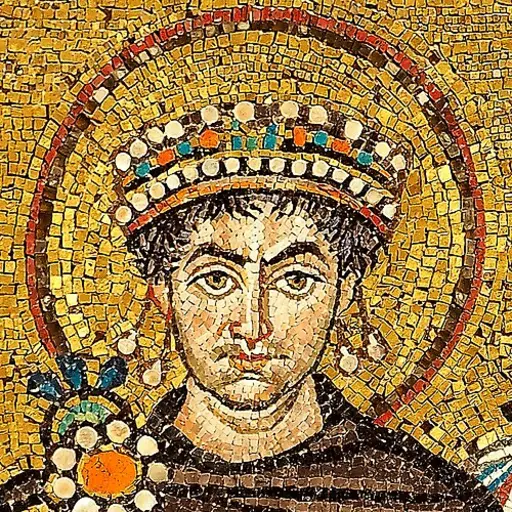

Oversaw the compilation of Roman law and for a time recovered the western Mediterranean.
Life
Son of a peasant family
Justinian came from a peasant family in the Balkans and was brought to court by his maternal uncle Justin I, commander of the Praetorian Guard; he took the throne in 527. By then the western provinces had fallen to Germanic kingdoms, and although the Eastern Roman Empire still held the wealth of Egypt and Syria, it faced pressure from Persia and unrest from the city factions.
Law code and reconquest
He had Tribonian compile the Code of Justinian, the Digest and the Institutes, systematically organizing Roman law. The Nika riots of 532 nearly toppled his regime, and Empress Theodora urged him to hold out. Afterward he rebuilt the Hagia Sophia Cathedral and sent Belisarius to recover North Africa, Italy and the southeastern coast of Spain.
Costs and legacy
The Reconquest came at enormous cost: Italy was ravaged by prolonged warfare, and the great plague from 541 sharply reduced the population, leaving the empire badly weakened; most of the lands he had gained were lost after his death. Yet his legal compilations, studied anew at medieval Italian universities, became the direct source of Europe's continental civil law tradition, with an influence that endures to this day.
Legacy
Justinian was the last Roman emperor whose native language was Latin, and he sought to restore the former territory and glory of the Roman Empire. The Corpus Juris Civilis compiled under his direction systematically preserved the essence of Roman law; revived by the Bologna glossators in the Middle Ages, it became the cornerstone of the continental civil-law tradition, and Hagia Sophia Cathedral is the pinnacle of Byzantine architecture. But constant warfare and the great plague exhausted the state, the territories he won were hard to hold, and his policy of religious unity deepened the rift with the Miaphysites.
Major works & achievements
- Oversaw compilation of the Corpus Juris Civilis
- Rebuilt the Hagia Sophia
- Recaptured North Africa, Italy and southeastern Spain
- Closed the Academy of Athens in 529 CE (the conventional account)
Did you know? According to Procopius, he had monks secretly bring silkworm eggs back from the East, and Byzantium thereby began raising silkworms and weaving silk on its own.
Key dates
- 527Becomes Eastern Roman emperor
- 529First edition of the Code of Justinian issued
- 532Nika riots crushed
- 533Belisarius conquers Vandal North Africa
- 534Revised Code and the Institutes completed
- 535Gothic War begins; advance into Italy
- 537Hagia Sophia completed
- 541Plague of Justinian breaks out
- 565Died