Khosrow I Anushirvan
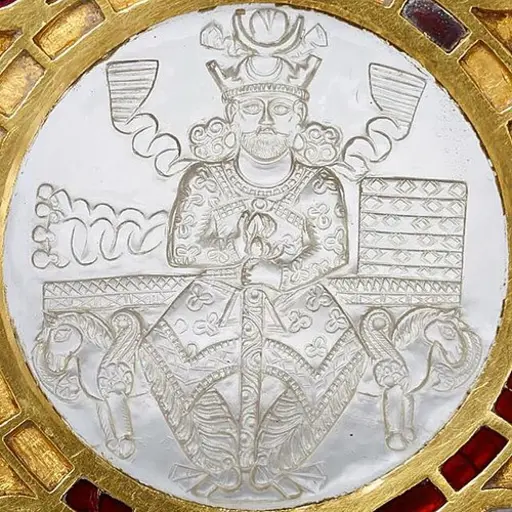

The most celebrated Sasanian monarch, who reformed the tax and military systems; known as "the Immortal Soul."
Life
Accession and suppressing revolt
Khosrow was the son of Kavad I and succeeded to the throne in 531. In his father's later years he had already taken part in suppressing the Mazdakite movement, which advocated the sharing of property and women and challenged the order of the nobility and priesthood. After his accession he executed the movement's leaders while setting about restoring the agriculture and social order damaged by the turmoil, redistributing ownerless land.
Tax and military reforms
He carried out far-reaching reforms: a fixed land tax levied according to the area of land and type of crop, along with a poll tax, stabilized state revenue; he divided the realm into four military districts and created a class of petty-noble cavalry equipped at state expense, weakening the private armies of the magnates. He also took in scholars of the Athens Academy closed by Justinian, and had the Panchatantra and chess introduced from India, while Gundeshapur became a center of medicine and learning.
The Just King
Abroad, Khosrow I Anushirvan captured Byzantine Antioch in 540 and signed a fifty-year peace treaty with Justinian in 562; in the east he allied with the Western Turks to destroy the Hephthalites, and c. 570 he sent troops to Yemen to expel the forces of Aksum. He reigned for nearly half a century and died in 579. Later Islamic sources call him "Anushirvan the Just," casting him as the model of a wise monarch.
Legacy
Khosrow I Anushirvan is regarded as the greatest monarch of the Sasanian Empire. His tax and military reforms revitalized the empire's finances and army, and his land-tax system was later inherited by the Arab conquerors, shaping the fiscal system of the early Islamic state. In Persian and Arabic literature he is the embodiment of the just and wise king, and the remains of the "Arch of Khosrow" at Ctesiphon, said to have been built in his time, still stand. Yet he crushed the Mazdakite movement with bloody methods, and his image of "justice" is partly the product of later idealization.
Major works & achievements
- Levied a fixed land tax according to acreage and crop
- Divided the realm into four great military districts and fostered a class of mounted knights
- Captured Antioch and concluded a fifty-year peace treaty with Byzantium
- Allied with the Western Turks to destroy the Hephthalites
- Introduced the Panchatantra and chess
Did you know? After the Academy of Athens closed, several philosophers sought refuge at his court; under the peace treaty of 532 CE they were later allowed to return to Roman territory.
Key dates
- 531Succession
- 532Signed the "Eternal Peace" with Byzantium
- 540Captured Antioch
- 560Allied with the Western Turks to destroy the Hephthalites (approximate)
- 562Signed a fifty-year peace treaty
- 570Sent troops to Yemen (approximate)
- 579Died