Theodora
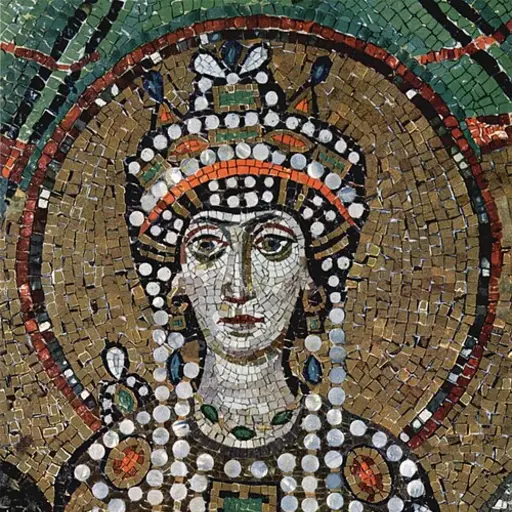

Of humble birth, she became empress and saved the regime by urging the court to hold out during the Nika riots.
Life
Humble origins
Theodora was born in Constantinople to an animal trainer's family and as a girl earned her living performing in the theater. Her low social standing would ordinarily have made it nearly impossible to rise into the upper ranks of rigidly hierarchical Eastern Roman society. She later met Justinian before his accession and the two fell in love; overcoming legal and public opposition, Justinian had his uncle change the marriage laws, and in 527 the two were crowned emperor and empress together.
Night of Nika
In 532 the Nika riots broke out in the capital: the chariot-racing factions joined discontented citizens in burning much of the city and even proclaimed a new emperor. As Justinian and his advisers debated whether to abandon the city and flee, Theodora firmly opposed flight in the imperial council, uttering the famous line "royalty is the finest burial shroud," which spurred Justinian to order the revolt suppressed and saved the regime. Afterward she was also active in religious policy and in legislation on women's rights, working to improve the legal status of abandoned infants, prostitutes and married women.
Two opposing images
Theodora was one of the few empresses in Byzantine history to be documented in detail by contemporary historians and to take a deep part in government. But the main source, Procopius, left both an official history praising her and the Secret History, which slanders her viciously; the two give completely opposite accounts of her private life, making it hard for later generations to judge which details are true and which are political attacks. This has made her one of the most polarizing figures in Byzantine history.
Legacy
Theodora is regarded as one of the most powerful empresses in Byzantine history. Together with Justinian she shaped the political and religious landscape of the 6th-century empire, and the Eastern Orthodox Church venerates her alongside Justinian as a saint. The laws she promoted to protect women were quite pioneering for their time. Procopius's "Secret History" portrays her as a debauched and vicious woman, but the work is clearly biased; modern scholars increasingly reassess her in light of her political talents and her position as a woman of humble origins.
Major works & achievements
- Urged holding out during the Nika riots, stabilizing the regime
- Promoted legislation protecting women's rights in marriage and property
- Sheltered persecuted Miaphysite clergy
Did you know? In the mosaic at the Basilica of San Vitale in Ravenna, she wears a jeweled crown and holds a chalice; it is the most famous image of a Byzantine empress.
Key dates
- 500Born c. in Constantinople
- 522Met Justinian
- 525Justinian had the marriage law changed
- 527Crowned together with Justinian
- 532Urged Holding out during the Nika riots
- 535Promoted better legal status for women
- 548Died of illness