Galileo Galilei
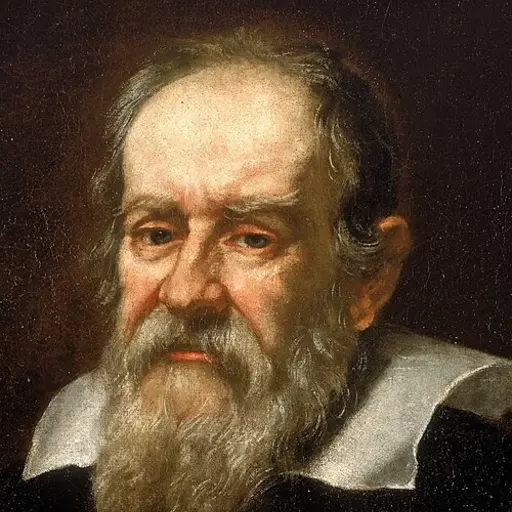

Supported heliocentrism with telescopic observations, laying the foundations of modern scientific method.
Life
Scholar of Pisa
Galileo Galilei was born in Pisa; his father was a music theorist. He first studied medicine but turned to mathematics and mechanics, teaching at the universities of Pisa and Padua. At the time natural philosophy in the universities was still dominated by the Aristotelian system, and astronomy had been mired in a long debate since Copernican heliocentrism was proposed.
Mechanics and the telescope
He studied falling bodies and motion on inclined planes, put forward the ideas of inertia and the composition of motions, and laid the groundwork for classical mechanics. In 1609 he improved the telescope and turned it to the sky, discovering the craters of the Moon, four moons of Jupiter, the phases of Venus and sunspots; in 1610 he published Sidereus Nuncius (Starry Messenger), providing strong observational evidence for heliocentrism.
Trial and house arrest
In 1632 he published the Dialogue Concerning the Two Chief World Systems; the following year he was tried by the Inquisition, forced to recant and placed under house arrest for life. During his house arrest he completed Dialogues Concerning Two New Sciences. He insisted on describing nature through mathematics and experiment and is regarded as one of the founders of modern scientific method, and his trial became an emblematic clash between science and authority.
Legacy
By combining systematic experiment, mathematical reasoning and telescopic observation, Galileo Galilei is hailed as one of the "fathers of modern science," and his work in mechanics laid the foundation for Newtonian mechanics. His conflict with the Church became the most famous case in the history of relations between science and religion, but historians also note that the affair equally involved scholarly disputes, personal temperament and papal politics. In 1992, Pope John Paul II formally acknowledged that the Church had erred in its treatment of him.
Major works & achievements
- Sidereus Nuncius (1610)
- Discovered four moons of Jupiter and the phases of Venus
- Dialogue Concerning the Two Chief World Systems
- Dialogues Concerning Two New Sciences
Did you know? The four largest moons of Jupiter, which he discovered, are still collectively called the "Galilean moons."
Key dates
- 1589Mathematics lecturer at the University of Pisa
- 1592Became professor at the University of Padua
- 1609Improved the telescope to observe the heavens
- 1610Published Sidereus Nuncius (Starry Messenger)
- 1616Warned by the Church not to promote heliocentrism
- 1632Published the Dialogue Concerning the Two Chief World Systems
- 1633Put on trial and recants; placed under house arrest for life
- 1638Published the Discourses on Two New Sciences
- 1642Died at Arcetri