Johannes Kepler
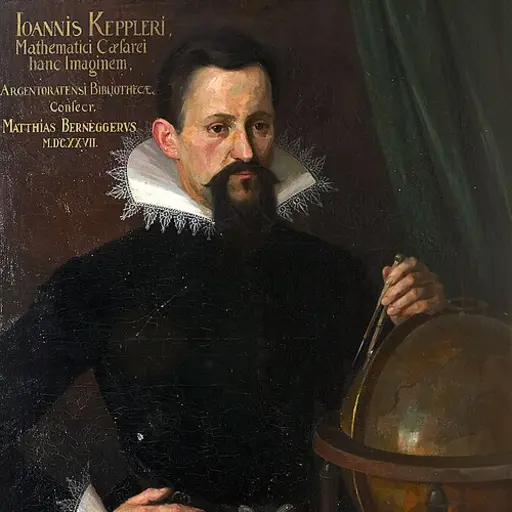

Derived the three laws of planetary motion from Tycho's data.
Life
Tübingen student
Kepler was born into a poor family in Württemberg, Germany. Smallpox in childhood damaged his eyesight, but he received a good education in mathematics and theology at the University of Tübingen, where he encountered the Copernican theory. As the conflict between Protestantism and Catholicism intensified, he was forced to move several times because of his faith, finding posts first in Graz and then in Prague.
Three laws of planetary motion
In 1600 he joined Tycho Brahe and inherited his detailed observations of Mars. After years of repeated calculation he discovered that planetary orbits are ellipses rather than perfect circles. He published the first two laws in 1609 and completed the third in 1619, turning heliocentrism from a hypothesis into a mathematical system capable of precise prediction; he also improved the optical theory of the telescope.
Faith and livelihood
He also worked part-time as an astrologer, casting horoscopes for the court and private clients to make a living, and became embroiled in a lawsuit in which his mother was accused of witchcraft, defending her in person for years before she was acquitted. Later generations often reduce him to a pure mathematical genius, overlooking his strong religious mysticism: he believed that discovering the laws of planetary motion revealed the geometric harmony of God's creation.
Legacy
Using Tycho's precise data, Kepler discovered the three laws of planetary motion, turning heliocentrism from a geometric hypothesis into a precise mathematical description and laying the direct foundation for Newton's law of universal gravitation. In optics he also explained image formation on the retina and the principles of the telescope. His thought interwove science and mysticism, and he constantly sought the mathematical harmony of the cosmos. In life he was long poor and moved from place to place; only after his death was he widely recognized as one of the founders of modern astronomy.
Major works & achievements
- Astronomia Nova (1609) set out the first two laws
- Harmonices Mundi (1619) set out the third law
- Rudolphine Tables (1627)
- Proposed the design of the Keplerian refracting telescope
Did you know? He wrote Somnium (The Dream), a work imagining a journey to the Moon, which is often regarded as an early work of science fiction.
Key dates
- 1589Encountered Heliocentrism at the University of Tübingen
- 1594Became a mathematics Teacher at a school in Graz
- 1600Joined Tycho as his Assistant
- 1601Tycho dies; Kepler inherits his observational data
- 1609Published the first two laws of planetary motion
- 1615Defended his Mother in a witchcraft trial
- 1619Published the third law
- 1627Published the Rudolphine Tables (Star catalog)
- 1630Died in Regensburg