Rodrigo Díaz de Vivar (El Cid)
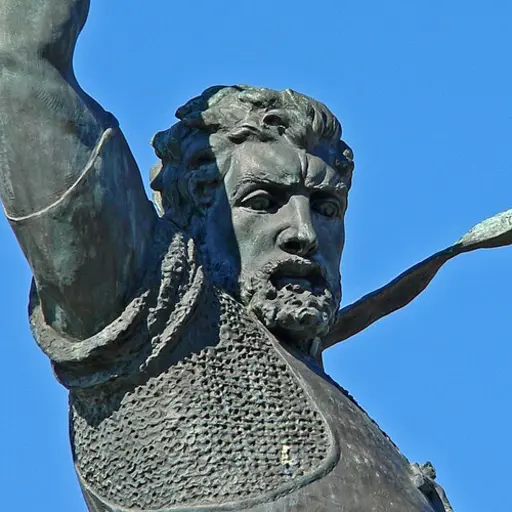

A career soldier who fought for both Christian and Muslim kings, he seized Valencia and later became Spain's national hero.
Life
Knight of Vivar
El Cid, whose real name was Rodrigo Díaz, was born c. 1043 in Vivar near Burgos. He grew up at the court of the Castilian prince Sancho and, when Sancho II took the throne, became commander of his army. In 1072 Sancho was assassinated and his brother Alfonso VI succeeded him; although Rodrigo transferred his loyalty to the new king and married his kinswoman Jimena, he never fully won the king's trust. "El Cid," from the Arabic for "lord," was what his contemporaries called him.
Exile and Campaigns
In 1081 he was exiled by Alfonso VI for launching a campaign without authorization, and he then entered the service of the Muslim taifa king of Zaragoza, defeating the Count of Barcelona at Almenar the following year. After the Almoravids crossed the sea, he alternately cooperated with and broke from Alfonso, gradually turning the taifas around Valencia into his own protectorates; in 1094 he captured the city of Valencia and in later battles drove back the Almoravid armies.
Valencia and the Epic
He ruled Valencia as an independent domain until his death in 1099; his widow Jimena held out until 1102 and then abandoned the city and withdrew north. The epic Cantar de mio Cid, composed about a century later, cast him as a loyal Christian hero, though in reality he had served Muslim rulers for years, a reflection of an age when religious boundaries could still be crossed.
Legacy
Rodrigo Díaz de Vivar (El Cid) is Spain's most famous national hero. The Cantar de mio Cid portrays him as a loyal and valiant Christian knight and is one of the founding works of Spanish literature. The historical El Cid was more of a professional commander who chose to serve Christian and Muslim rulers alike, and his career reflects how fluid religious and political boundaries were in the era of the Reconquista. Modern nationalist historiography further mythologized his image, and modern historians have reflected critically on this.
Major works & achievements
- 1082: Defeats the Count of Barcelona at Almenar
- Captured Valencia in 1094
- Repeatedly repelled Almoravid armies
- Hero of the epic Cantar de mio Cid
Did you know? Since 1921, his remains and those of his wife Jimena have been buried together in Burgos Cathedral.
Key dates
- 1043Born in Vivar around this year
- 1065Commander of Sancho II's army
- 1074Marries Jimena
- 1081Exiled by Alfonso VI, enters the service of Zaragoza
- 1082Defeats the Count of Barcelona at Almenar
- 1094Captures Valencia
- 1099Died in Valencia