Queen Nzinga
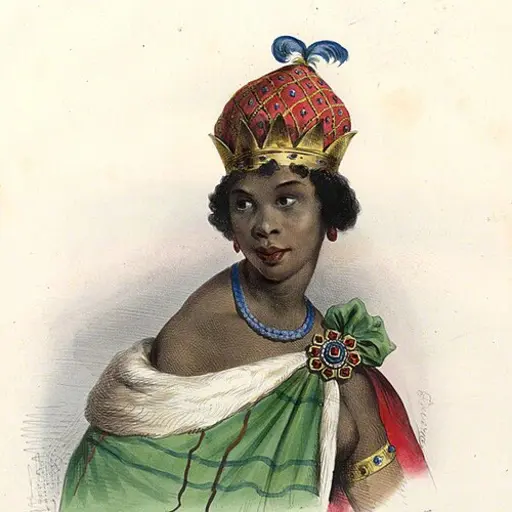

Allied with the Netherlands against Portuguese colonial expansion and ruled for nearly forty years.
Life
Negotiations at Luanda
Nzinga was born into the royal family of the Kingdom of Ndongo, at a time when Portugal had already established the colonial outpost of Luanda on the coast of west-central Africa and was penetrating the interior through military pressure and the slave trade. Early on, as an envoy sent by her elder brother to negotiate in Luanda, she once had an attendant kneel on the ground as a seat when the Portuguese refused to provide her a chair at the talks, thereby upholding her dignity.
Queen of two kingdoms
After her elder brother died she seized power and ruled the two kingdoms of Ndongo and Matamba for nearly forty years. She repeatedly shifted alliances, at times making peace with Portugal and being baptized a Catholic, at times joining the Dutch East India Company to fight the Portuguese, and she took in runaway slaves and enrolled them in her army, making her one of the most enduring rulers in west-central Africa to resist European colonial expansion.
Peace and legacy
In her later years she concluded a peace treaty with Portugal that allowed a degree of trade. This pragmatic diplomacy is often simplified as a "surrender" or, conversely, overly mythologized as that of an "uncompromising anti-colonial hero"; both narratives are one-sided. Her exact year of birth differs by several years between local oral tradition and Portuguese archival records.
Legacy
Through flexible diplomacy and sustained armed resistance, Nzinga preserved her realm for nearly forty years during the most aggressive period of Portuguese colonial expansion, and today's Angola regards her as a national hero and a symbol of anti-colonialism. She also took part in the slave trade and used any means in her struggles for power, so historians generally argue for judging her in her specific context, neither simply deifying her nor dismissing her wholesale as a "compromiser."
Major works & achievements
- Mission to Luanda to negotiate with Portugal
- Seized the Kingdom of Matamba
- Allied with the Netherlands against Portugal
- Concluded a peace treaty with Portugal in 1656
Did you know? She was baptized in Luanda in 1622 under the Christian name Anna de Sousa, and Portuguese sources often refer to her by this name.
Key dates
- 1622Went as envoy to the Negotiations at Luanda
- 1624Her elder brother died; she succeeded to the throne
- 1626Driven from the Ndongo royal capital
- 1631Seized the Kingdom of Matamba
- 1641Allied with the Netherlands against Portugal
- 1656Concluded a peace treaty with Portugal
- 1663Died