René Descartes
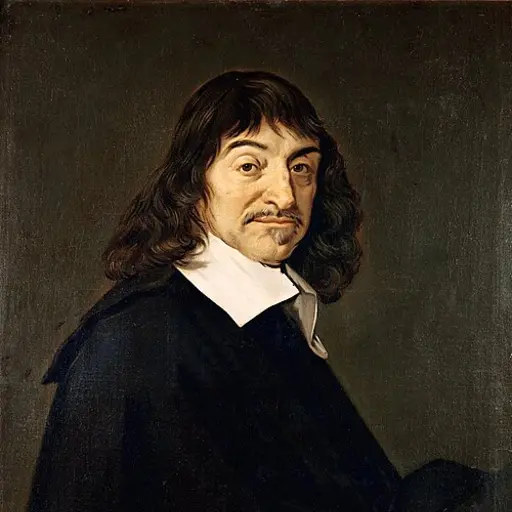

Laid the foundations of modern rationalist philosophy with his method of systematic doubt.
Life
Military service and travels
Descartes was born into a family of petty nobles in Touraine, France. After graduating from a Jesuit college he joined the army and traveled across Europe, witnessing the early campaigns of the Thirty Years' War. At the time, Scholasticism still centered on commentaries on Aristotle; doubting the reliability of the existing body of knowledge, he moved to the Netherlands, which was relatively tolerant in religion, to devote himself to writing.
I think, therefore I am
In 1637 he published Discourse on the Method, proposing to start by doubting everything and to rebuild the edifice of knowledge from the unshakable starting point of "I think, therefore I am." In an appendix he set out analytic geometry, combining algebra and geometry. He also proposed mind-body dualism and a mechanistic view of nature, seeking to explain the physical world in a unified way through mathematical methods.
Death in Sweden
In his later years he went to Stockholm at the invitation of Queen Christina of Sweden to teach her. Unused to giving lessons in the bitterly cold early mornings there, he contracted pneumonia and died a few months later. Later generations often reduce his thought to the single slogan "I think, therefore I am," overlooking his extensive work in optics, physiology and analytic geometry; his mind-body dualism has also been heavily criticized by later philosophers because it struggles to explain how mind and body interact.
Legacy
Descartes is widely regarded as the founder of modern philosophy. He used the method of doubt to find a starting point for certain knowledge, making epistemology the central question of philosophy, and together with Spinoza and Leibniz he formed the tradition of Continental rationalism. His analytic geometry united algebra and geometry, paving the way for calculus. His mind-body dualism and mechanistic view of nature remain subjects of repeated discussion and criticism in philosophy and cognitive science today.
Major works & achievements
- Discourse on the Method
- Meditations on First Philosophy
- Principles of Philosophy
- Founded analytic geometry
Did you know? The Cartesian coordinate system is named after him, from his Latin name.
Key dates
- 1618Joined the Dutch army and traveled across Europe
- 1628Settled in the Netherlands to write
- 1633Shelved his astronomical treatise after the trial of Galileo Galilei
- 1637Published Discourse on the Method
- 1641Published Meditations on First Philosophy
- 1644Published Principles of Philosophy
- 1649Invited to teach at the Swedish court
- 1650Died of illness in Stockholm