Mani
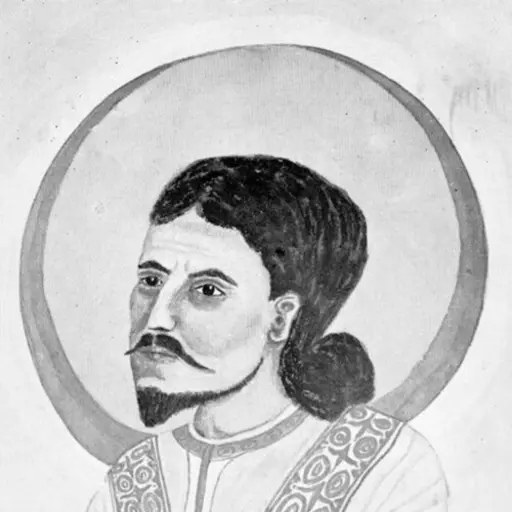

Blended Zoroastrianism, Christianity and Buddhism to found the dualist religion of Manichaeism.
Life
Youth among the Baptists
Mani was born in southern Babylonia under the Sasanian Empire. As a child he joined his family in a Jewish-Christian sect devoted to baptism and ascetic practice, and as a young man he claimed to have received a series of divine revelations, holding that the earlier prophets of the various religions, Zoroaster, the Buddha and Jesus, had conveyed only part of the truth.
Founded Manichaeism
Combining Zoroastrian dualism of light and darkness, Christian ideas of salvation and the Buddhist idea of rebirth, he founded Manichaeism, teaching that the two principles of light and darkness are locked in eternal struggle and that people should help the light escape the bonds of matter through abstinence and spiritual discipline. Shapur I was relatively tolerant of him during his reign, so he was able to send apostles east along the Silk Road, and his community at one point reached as far as Central Asia and China.
Martyrdom and spread
After Shapur I's death, the Zoroastrian priesthood that came to power regarded Manichaeism as heresy. Around 274 CE he was arrested and imprisoned on the orders of Bahram I and soon died in prison; some later legends dramatize that he was flayed and put on display. Manichaeism was then brutally suppressed in Persia proper, yet it survived for centuries in Central Asia, China and even the Mediterranean world, and its doctrinal structure of "dualistic opposition, with light ultimately triumphant" has often been loosely lumped together by later generations with other "heretical" movements.
Legacy
Manichaeism was once one of the most widespread religions of antiquity, reaching west to North Africa and Rome and east to China; in the 8th century it was for a time the state religion of the Uyghur Khaganate, and Augustine of Hippo was a follower in his youth. After reaching China in the Tang dynasty it was also called "Mingjiao," and in the Song and Yuan periods it evolved into a folk religion in Fujian and elsewhere. Long branded heretical and suppressed by the Christian Church and Zoroastrian priests, most of its original scriptures were lost, and only the discovery of manuscripts at Turpan, Dunhuang and other sites in the 20th century greatly advanced its study.
Major works & achievements
- Founded Manichaeism, teaching a dualism of light and darkness
- Wrote the Shabuhragan and presented it to Shapur I
- Wrote scriptures himself and illustrated them
- Sent apostles to preach east and west
Did you know? The stone statue of Mani the Buddha of Light at Cao'an in Jinjiang, Fujian, is believed to be the only surviving Manichaean stone statue in the world.
Key dates
- 216Born in southern Babylonia
- 228Joined a baptist sect as a child
- 240Claimed to have received revelation and founded a new doctrine
- 242Permitted by Shapur I to preach
- 260Sent apostles east to Central Asia and India
- 273Imprisoned after his successor Bahram I took the throne
- 274Died in prison (one account says he was executed and flayed)