Zhuge Liang
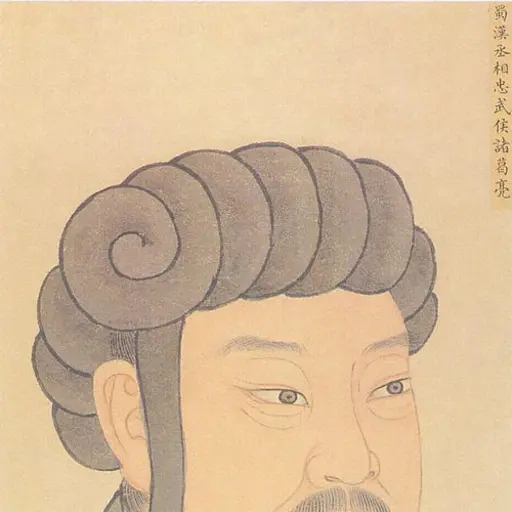

Proposed the Longzhong Plan and helped Liu Bei found his state; his strict and fair rule of Shu earned him later renown as a worthy minister.
Life
Sleeping Dragon of Longzhong
Zhuge Liang came from a gentry family of Langya. In his early years he followed his uncle to Jingzhou, farmed near Nanyang and associated with the notable scholars of the Jing-Xiang region, who called him the Sleeping Dragon. By then Cao Cao had pacified the north, while Liu Bei, defeated time after time and living as a guest in Jingzhou, urgently needed a long-term strategy, and so made the Three Visits to the Thatched Cottage to seek him out.
Helped Liu Bei found Shu
At Longzhong he proposed a strategy of holding both Jing and Yi provinces and allying with Wu against Cao Cao. After the Battle of Red Cliffs he helped Liu Bei take Jingnan and enter Yizhou, founding Shu Han. After Liu Bei's defeat at Yiling and his deathbed entrusting of his heir, Zhuge Liang governed as chancellor: he led a southern campaign that pacified Nanzhong, cleaned up the administration, built irrigation works and kept strict military discipline, and led five northern expeditions against Cao Wei, all halted by the limits of grain transport and national strength.
Devoted to the very end
In 234 CE he died of illness in camp at the Wuzhang Plains, leaving orders for a simple burial. His rule of Shu was guided by law yet the people did not resent it, and later ages saw him as the model of a worthy chancellor. His Memorial on Dispatching the Troops was very widely read, and the novel Romance of the Three Kingdoms went further, deifying him as the embodiment of cunning strategy, a considerable distance from the cautious, pragmatic figure in the histories.
Legacy
Zhuge Liang is the model of the loyal minister and wise chancellor in Chinese history. Chen Shou judged him "a fine talent who understood governance, a match for Guan Zhong and Xiao He," while noting that "adapting to circumstances in military command was not his strength." His openness, fairness and strict rewards and punishments in governing Shu have been praised through the ages, and Du Fu's lines "He died before his campaign could triumph, forever leaving heroes' tears to soak their robes" fixed his image in people's hearts. The Romance of the Three Kingdoms made him an almost deified figure of wisdom, and stories such as "Borrowing the East Wind" and the "Empty Fort Strategy" are mostly literary fiction.
Major works & achievements
- Proposed the Longzhong Plan for dividing the realm into three
- Brokered the Sun-Liu alliance against Cao Cao
- Assisted the government as chancellor; his southern campaign pacified Nanzhong
- Led five northern expeditions against Cao Wei
- Memorial on Dispatching the Troops; Admonition to My Son
Did you know? The Wuhou Shrine in Chengdu adjoins the Temple of the Zhaolie Emperor of Han, a rare case in China of a ruler and his minister being worshipped together in one shrine complex.
Key dates
- 207Liu Bei made the Three Visits to the Thatched Cottage; proposed the Longzhong Plan
- 208Went as envoy to Eastern Wu, bringing about the alliance against Cao Cao
- 214Entered Yizhou with the army; appointed General of the Military Advisers
- 221Shu Han founded; became chancellor
- 223Entrusted with the heir by Liu Bei; assisted Liu Shan
- 225Southern campaign pacifies Nanzhong
- 227Submitted the Memorial on Dispatching the Troops and advanced to Hanzhong
- 228First Northern Expedition; setback at Jieting
- 234Dies of illness at Wuzhang Plains