Wen Tianxiang
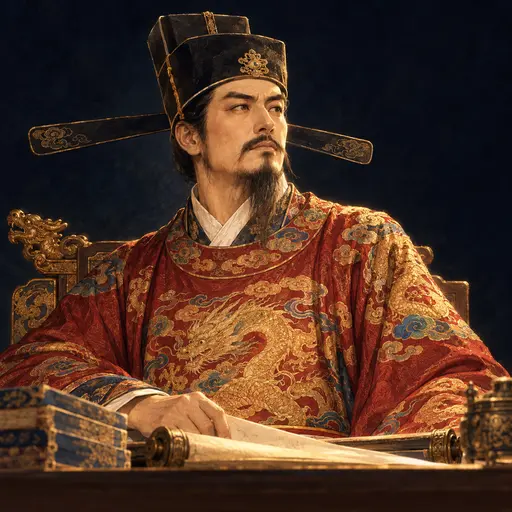
Captured while resisting the Yuan, he was held in Dadu for three years and died a martyr unbowed, leaving behind the "Song of Righteous Spirit."
Life
Top scholar in the examinations
Wen Tianxiang placed first in the palace examination at 20. In 1275, as the Yuan army advanced south, he donated his family fortune to recruit a volunteer army and raised troops to save the throne. The following year he was detained while negotiating as an envoy in the Yuan camp, escaped at Zhenjiang, and made his way back south to continue resisting the Yuan.
Raised troops to save the throne
In 1278 he was captured by the Yuan army at Wupoling in Haifeng, Guangdong. When the Yuan general Zhang Hongfan pressed him to write a letter urging Zhang Shijie, who was holding out at Yamen, to surrender, he answered with "Crossing the Lingding Sea": "Since ancient times, who has escaped death? Let me leave a loyal heart to shine in the annals of history."
A loyal heart to shine in the annals
He was taken to Dadu and held prisoner for three years. Emperor Shizu (Kublai Khan) himself urged him to submit, but he never yielded, and in prison he wrote the "Song of Righteous Spirit." In 1283 he went calmly to his execution at the Chaishi market in Dadu.
Legacy
Wen Tianxiang's unyielding integrity made him a symbol of national integrity in Chinese history, and with Lu Xiufu and Zhang Shijie he is known as one of the "Three Heroes of the Late Song."
Major works & achievements
- "Crossing the Lingding Sea"
- "Song of Righteous Spirit"
Did you know? After his martyrdom, people found his last words in the sash of his robe: "Confucius spoke of achieving humaneness, Mencius of choosing righteousness..."
Key dates
- 1256Placed first in the palace examination
- 1275Raised troops to save the throne
- 1278Captured at Wupoling
- 1279Wrote "Crossing the Lingding Sea"
- 1283Executed at Dadu for his loyalty