Ram Khamhaeng
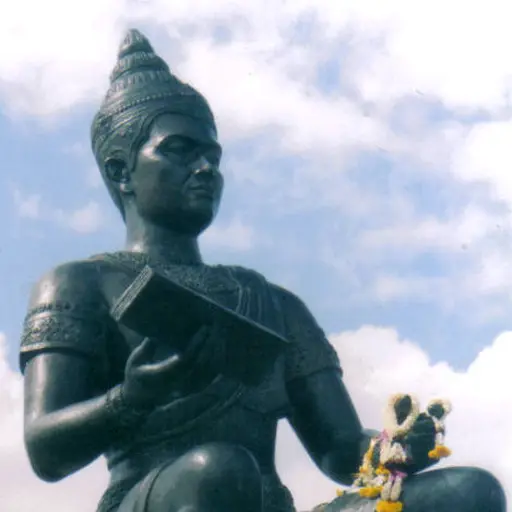

King of Sukhothai at its zenith, traditionally credited with creating the Thai script.
Life
Rama the Bold
Ram Khamhaeng was the third son of Si Inthrathit, founding monarch of Sukhothai. According to his own account in the Ram Khamhaeng Inscription, at the age of 19 he went to war with his father and, fighting from elephant-back, dueled and defeated an invading chief from a neighboring realm; his father therefore gave him the name "Ram Khamhaeng," meaning "Rama the Bold." After his elder brother Ban Mueang died, he succeeded to the throne c. 1279, becoming the third king of Sukhothai.
Expansion and Script
Under his rule Sukhothai's influence extended south to the Nakhon Si Thammarat area of the Malay Peninsula and west into the Mon lands, and he allied with King Mangrai of Lanna and King Ngam Mueang of Phayao to the north; he is said to have helped choose the site of Chiang Mai. The inscription states that in 1283 he created the Thai script on the model of the Khmer and Mon scripts, and it paints a picture of benevolent government in which "there are fish in the water and rice in the fields" and subjects could ring a bell to petition the king; he also patronized Theravada Buddhism from Ceylon.
The Great King and the Inscription Controversy
In Thailand Ram Khamhaeng is honored as "the Great," the model of the benevolent "father-king." His inscription is listed in UNESCO's Memory of the World Register. Since the 1980s, however, some scholars have suspected that the stone is a 19th-century creation and that the idealized rule it describes may not reflect reality; most scholars still lean toward regarding the inscription as broadly authentic, but the details of his life rest largely on this single source.
Legacy
Ram Khamhaeng is revered in Thailand as "the Great" and regarded as the creator of the Thai script and a model of benevolent government; his image is an important part of Thailand's national historical narrative. He expanded Sukhothai's power and patronized Theravada Buddhism, influencing Thai religious culture thereafter. Because what we know of his life relies mainly on the Ram Khamhaeng Inscription, whose date has been questioned, many details of his deeds remain academically disputed.
Major works & achievements
- According to the inscription, created the Thai script in 1283
- Extended Sukhothai's influence to the Malay Peninsula
- Allied with Lan Na and Phayao
- Embraced Sri Lankan Theravada Buddhism
Key dates
- 1238His father Si Inthrathit founds Sukhothai (conventional date)
- 1279Succeeds his elder brother Ban Mueang as king around this year
- 1283Creates the Thai script, according to an inscription
- 1292Year recorded in Inscription No. 1 (the Ram Khamhaeng Inscription)
- 1296Plans the founding of Chiang Mai with Mangrai and Ngam Mueang
- 1298Dies c. this year; succeeded by his son Loe Thai