Jia Yi
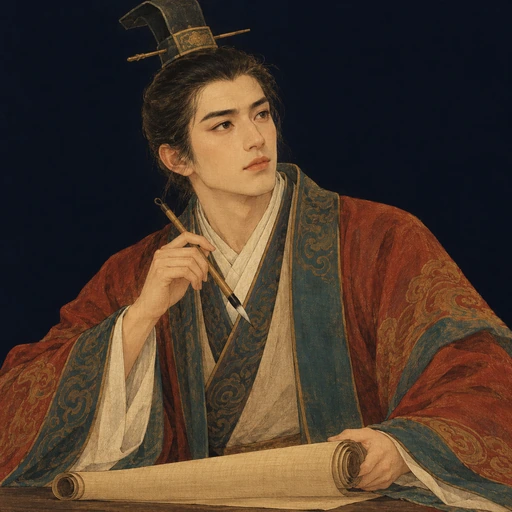
A young prodigy who wrote "The Faults of Qin" and died young of depression after being exiled to Changsha.
Life
Talent of Luoyang
Jia Yi was famed in Luoyang for his writing at 18. In his early twenties he was summoned by Emperor Wen as an academician and within a year was promoted to grand palace grandee, proposing a series of reforms such as revising the calendar, changing the color of court dress and fixing the names of offices.
Demoted to Changsha
Pushed out by veteran ministers such as Zhou Bo and Guan Ying, he was demoted to tutor of the Prince of Changsha. Passing the Xiang River on the way, he wrote the "Lament for Qu Yuan," comparing himself to Qu Yuan.
The Faults of Qin
He was later recalled to serve as tutor to Prince Huai of Liang and wrote the "Memorial on Order and Peace," advocating weakening the feudal princes and resisting the Xiongnu. His "The Faults of Qin" summed up the lessons of the Qin dynasty's fall: "Because it failed to practice benevolence and righteousness, the positions of attacker and defender were reversed." When Prince Huai of Liang died after falling from a horse, Jia Yi blamed himself bitterly and died in 168 BCE, aged only 33.
Legacy
Jia Yi's political essays deeply influenced Han policy, and "The Faults of Qin" is a celebrated piece in the history of Chinese prose; his unrecognized talent also became a shared lament of later literati.
Major works & achievements
- "The Faults of Qin"
- "Memorial on Order and Peace"
- "Lament for Qu Yuan"
Did you know? Li Shangyin's lines "Pity that at midnight the emperor leaned forward in vain, asking not about the common people but about ghosts and spirits" describe Emperor Wen's audience with Jia Yi.
Key dates
- 178 BCESummoned by Emperor Wen as an academician
- 176 BCEDemoted to tutor of the Prince of Changsha
- 173 BCEWrote "Memorial on Order and Peace" (approx.)
- 168 BCEDied