Xunzi
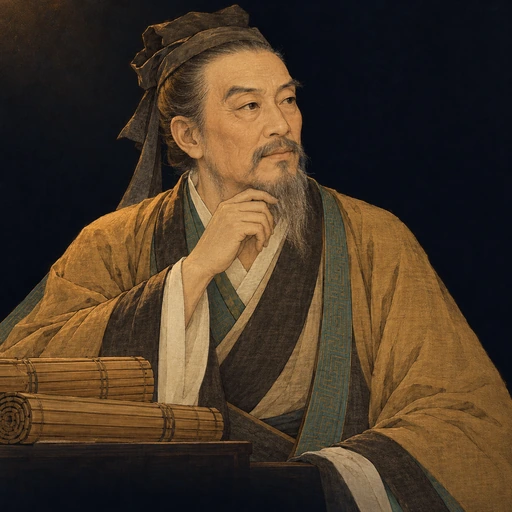
Held that human nature is evil and advocated using both ritual and law; taught Han Fei and Li Si.
Life
Libationer of the Jixia Academy
Xunzi, named Kuang, was a native of the State of Zhao. At fifty he went to study in the State of Qi, where he served three times as libationer (head) of the Jixia Academy and was the most prestigious scholar of his day.
Human nature is evil
He held that human nature is evil and must be reshaped through learning and ritual propriety, so he stressed education and the combination of ritual and law. The opening line of his Exhortation to Learning, "Learning must never cease," is still quoted today. He also argued for "mastering Heaven's decree and putting it to use," believing that people could grasp the laws of nature.
Writing at Lanling
Later he went to the State of Chu, where Lord Chunshen made him magistrate of Lanling. After Lord Chunshen's death he was dismissed, and he spent the rest of his life writing in Lanling. His students Han Fei and Li Si both became Legalist figures.
Legacy
Xunzi was one of the great synthesizers of pre-Qin Confucianism, standing opposite Mencius's doctrine that human nature is good; his thought also led toward Legalism, making him a bridge between Confucianism and Legalism.
Major works & achievements
- Xunzi
Did you know? The saying "Blue comes from the indigo plant, yet it is bluer than the plant" comes from his "Exhortation to Learning."
Key dates
- 264 BCEServed as libationer of the Jixia Academy (approx.)
- 255 BCEBecame Magistrate of Lanling in the State of Chu
- 238 BCEDismissed after Lord Chunshen's death; spent his last years writing (approx.)